
Type rheem vs bradford white water heater into a search box and you get spec sheets. That is the wrong end of the problem. This comparison is settled before a single specification matters, because Bradford White does not sell through retail at all. There is no Saturday-afternoon Bradford White. You get one by having a plumbing contractor buy it for you at a wholesale counter, which makes the decision a choice between two ways of acquiring a water heater rather than two ways of heating water.
Rheem stands on the other side of that line with both feet. It sells one ladder of tanks with a price sticker on a big-box shelf and a second ladder through wholesale distributors, and the two ladders come out of the same plants. If you have read the site’s comparison of the two big retail badges, you know I think most brand arguments are noise. This one is not. The channel is real, and it changes the price you can see, the person who selects the model, and who answers the phone when the thing leaks.
The short answer
- Tank failed this morning, no hot water in the house: Rheem, because it is the one you can physically leave a store with today. Buy the highest warranty tier on the shelf, not the cheapest box.
- You have a plumber you use and trust, and a week to plan: Bradford White is a fine tank, and the wholesale-only channel stops being a drawback when the person picking the model is the person who has to come back if it fails.
- You want to compare prices before committing: Rheem. Bradford White has no published consumer price, so the number you get is a quote, and quotes bundle equipment with labor you cannot unbundle.
- You are optimizing ten-year running cost: neither badge decides that. The UEF printed on the model you pick decides it, and both brands sell models across the same 0.60 to 0.70 band for gas storage.
- You are buying for a rental or a flip: Rheem, on availability, and on the fact that any plumber in the country can source the parts without a relationship.
- You are trying to settle a forum argument about which one lasts longer: you cannot. No public model-level failure database exists for water heaters in the United States. That is not a dodge, it is the state of the evidence.
The channel is the product
Bradford White builds in Michigan and New Hampshire and sells everything it makes through plumbing and heating wholesalers. Not as a preference. As a policy. Walk into a supply house without a trade account and in most of the country you are not walking out with one. The practical consequence is that the model, the capacity and the warranty tier get chosen by your contractor from whatever the local distributor stocks, and the paperwork trail on a failure runs back through that contractor rather than through a returns desk.
Rheem runs two ladders at once. The retail ladder is the one most people meet: three tiers stacked by warranty length and features, priced openly, stocked in 40 and 50 gallon sizes in almost every store. The wholesale ladder carries different model numbers and different trim, sold to contractors through the Rheem distributor network. Same company, same tank technology, different route to your basement. The same badge logic runs through the group’s other names, which I unpicked in the piece on Ruud, Richmond and Reliance against Rheem, and it is worth reading before you assume a nameplate tells you anything about the steel.
One thing I will not do here is price the installation. Labor rates for a tank swap are local, they move with the metro and the venting situation, and any national figure quoted for them is decoration. Equipment price is comparable across brands, so that is the number I will use. The rest is your market, not mine.
Rheem vs Bradford White water heater, side by side
| criteria | RHEEMretail and wholesale | BRADFORD WHITEwholesale only |
|---|---|---|
| Where you buy it | Two channelsbig-box shelf plus distributor counterswider net | One channela licensed trade buyer purchases it for you |
| Price visible before you commit | $700–$1,30050 gal gas, printed on the shelftransparent | Quotedno published consumer list price |
| Replacement available today | Usually40 and 50 gal held in store stockemergency win | Rarelydepends on what the contractor supplier holds |
| Breadth of line | Very widegas, electric, hybrid, tankless, commercialone badge covers the house | Focusedtanks and indirects first, plus tankless and hybrid |
| Tank lining | Glass-lined steelproprietary enamel, no comparative test published | Vitraglasenamel with an antimicrobial additive |
| Cold inlet and sediment | EverKleenself-cleaning dip tube on gas models | Hydrojetdiffuser inlet that keeps the tank floor moving |
| Warranty ladder | 6 / 9 / 12 yrtiers you choose between on the shelfpublished and comparable | 6 yr typicallonger on selected models, read the sheet |
| Public failure data | Noneno model-level database exists | Nonetrade consensus is not measurement |
Leaking tank, today? Rheem, in the highest warranty tier you can stretch to, because availability beats every other criterion when the water is already on the floor. Planned replacement with a contractor you rate? Bradford White, and let them pick the model, because the wholesale channel puts the choice and the accountability in the same pair of hands.
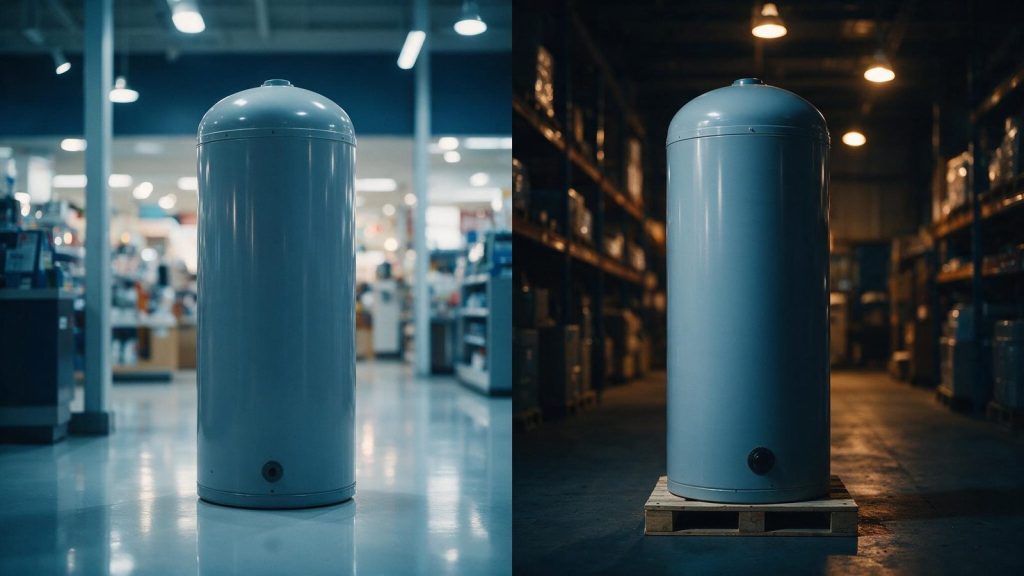
What the two firms genuinely build differently
Strip out the marketing and three design areas are documented well enough to discuss. The first is the lining. Both companies fuse a glass enamel to the inside of a steel tank, and Bradford White brands its version Vitraglas and blends an antimicrobial additive into it. Neither firm publishes a comparative corrosion test against the other, so the honest statement is that both use the same class of protection and nobody outside those two labs knows whose enamel wins.
The second is the cold water inlet. Sediment settling on the floor of a gas tank sits between the burner and the water and makes the burner work harder for the same delivered heat. The Hydrojet inlet on a Bradford White is a diffuser designed to keep that layer stirred. The EverKleen dip tube on a Rheem goes at the same problem with a different geometry. Both are real engineering answers to a real problem, and both matter more in hard water than in soft. I am not going to tell you how to flush a tank. I will tell you that the sediment clock runs on water chemistry, not on the calendar.
The third is the anode. Every glass-lined tank carries a sacrificial rod, magnesium as standard on residential units from both firms, aluminum alloy offered where the local water calls for it. The rod is a consumable. When it is spent the steel starts corroding, and that single fact explains more about how long a tank lasts than either badge does. The mechanism deserves its own treatment, which is why I wrote up the failure curve behind the 8-to-12-year figure separately.
The number the badge does not set
Running cost is where readers expect a brand comparison to produce a winner, and it refuses to, because efficiency is a property of the model tier rather than the nameplate. Here is the arithmetic on a standard household. Delivering hot water for 64 gallons a day at a 70 °F rise takes roughly 4,000 kWh of delivered heat a year. Convert that into gas units: 4,000 kWh multiplied by 3,412 Btu is about 13.6 million Btu, which is 136 therms of heat that has to end up in the water.
Now divide by the efficiency of the appliance. A basic gas storage tank at UEF 0.60 has to burn 136 ÷ 0.60 = 227 therms to deliver that, which is $341 a year at $1.50 a therm. A better one at UEF 0.70 burns 136 ÷ 0.70 = 195 therms, or $292. The gap is $49 a year, near enough $490 across ten years, and it is available inside either brand catalog. Buy a Bradford White at the bottom of its efficiency band and a Rheem at the top and the Rheem wins on fuel. Reverse the pairing and the result reverses. The badge contributed nothing either way.
So the useful move is to stop shopping the jacket and start shopping the spec line. Pull the model number, look it up in the AHRI directory, read the UEF and the first-hour rating, and weigh both against the price. That works whether the tank came off a retail shelf or a wholesaler rack. It is the same discipline that makes the wider brand rankings question answerable at all, which is to say barely, and only by need.
The durability argument nobody can settle
Ask any plumbing forum and you will be told Bradford White outlasts Rheem. The claim arrives with total confidence and rests on nothing you can check. There is no public, model-level failure database for water heaters in the United States. No regulator collects one, neither manufacturer publishes one, and warranty claim rates stay inside the companies. What the forums report is a real signal from a badly biased sample: contractors mostly install one brand, mostly get called back to tanks they did not install, and mostly work inside one water district.
That last point does the heavy lifting. Water hardness varies by more than a factor of ten across American municipal supplies, and hardness drives the anode clock. Two identical tanks, one in Tampa and one in Portland, will not fail in the same year. A brand-level lifespan claim built from one contractor territory is really a claim about that territory’s water. I keep meeting people who moved cities, watched a tank die early, and concluded the new brand was junk, when what actually changed was the mineral content coming through the meter.
The closest thing to published reliability data either firm offers is the warranty tier, because that is the manufacturer betting its own money on the anode and the lining. Read it as a signal rather than a promise, and read the exclusions while you are there. If you want the same argument run against the other brand that lives in both channels at once, it is over in Bradford White against A.O. Smith.
Here is where my own recommendation breaks, and it breaks badly. I have told you to shop the spec rather than the badge, and that is right for a purchase you can plan. It is wrong at six in the morning with a wet basement. In that situation the correct water heater is the one that can be installed before dinner, the spec sheet is irrelevant, and anybody telling you to research UEF first has never stood in that water. Availability is a feature. Bradford White, by design, does not offer it.
Sources
- AHRI Directory of Certified Product Performance, for model-level UEF and first-hour rating on both brands.
- Rheem and Bradford White residential specification sheets and use-and-care manuals, for lining, cold inlet and anode descriptions.
- Rheem and Bradford White residential limited warranty documents, for tank and parts terms and exclusions.
- FTC EnergyGuide labels, for the estimated annual energy cost printed on each unit.
- DOE Energy Saver, for uniform energy factor definitions and storage water heater guidance.
- US Energy Information Administration, for residential natural gas and electricity price data.
Two competent tanks, then, separated less by their steel than by how they reach you. Pick the channel that fits your situation, pick the tier inside it using the arithmetic above, and ignore what is printed on the jacket. Every assumption behind these numbers, and the way we build the comparisons, is laid out on the method page.