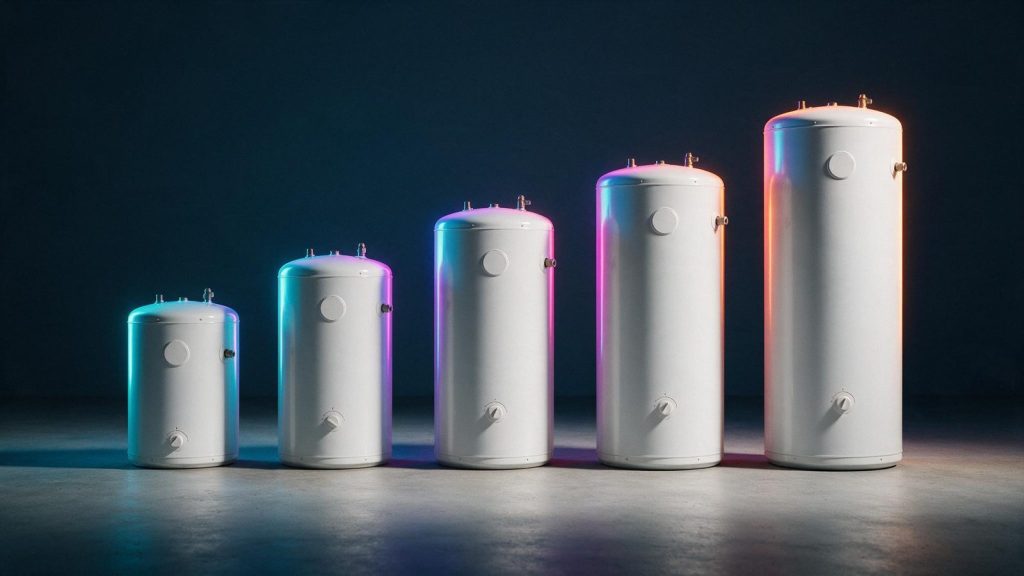
Water heater sizes are printed in gallons, and the gallons are the least useful number on the box. A 50 gallon tank does not hand you 50 gallons of hot water. It hands you roughly 35 before the outlet temperature falls far enough that the shower stops being a shower, and then it hands you whatever the burner or the elements can put back while you keep drawing. Those are two separate quantities. The label only tells you about the first one.
The number that answers the question you are actually asking is the first hour rating, printed on the yellow EnergyGuide label. It is measured rather than declared, and it splits hard between a gas tank and an electric tank of identical nominal size. If you have an evening to spend on this, run the sizing worksheet this site uses against your own fixtures. If you are standing in an aisle with a dead tank at home, read the table below instead.
The short answer
- One or two people, one bathroom: 30 gallons of gas, or 40 of electric. A 30 gallon electric is genuinely tight and I would not buy one to save sixty dollars.
- Three people, one bathroom, showers spread across the morning: 40 gallon gas or 50 gallon electric. Different labels, near enough the same real delivery.
- Four people, two bathrooms, overlapping mornings: 50 gallon gas, or 80 gallon electric. The gap between those two labels is recovery speed, not storage.
- A soaking tub over 60 gallons: stop counting people and size to the tub. Nothing below a 75 gallon gas tank fills a big tub and still leaves someone a shower.
- Replacing like for like in a tight closet: measure the alcove before you look at any spec. The 50 that fits beats the 65 that does not.
- Shopping a heat pump: read the first hour rating for the mode you will actually leave it in, not the headline one.
Why the gallon number is not the capacity
Inside a storage tank the hot water floats on the cold. Mains water enters at the bottom through a dip tube, hot leaves from the top, and the boundary between the two layers climbs as you draw. That layering is the only reason a tank works at all. It is also what limits it, because long before the tank runs out of warm water the outlet temperature starts sliding, and a slide of twenty degrees is the difference between a shower and a complaint.
The federal test procedure puts a hard line on that point. The first hour rating test starts with a fully heated tank, draws at a fixed rate, and stops counting once the water coming out is 25 °F below where it started. For most residential storage tanks the draw stops being counted somewhere near 70 percent of nominal volume. Thirty-five gallons out of a 50. Twenty-eight out of a 40. Fifty-six out of an 80. That is the storage half of the answer, and it is fixed by geometry.
The other half is recovery, meaning whatever the heat source adds while you are still drawing. Usable storage plus one hour of recovery is, near enough, the first hour rating. Which is how the same 50 gallons ends up behaving like two different appliances depending on what is sitting under it.
Side by side
| Nominal sizewhat the label says | GAS STORAGEatmospheric, typical FHR | ELECTRIC RESISTANCE4,500 W, typical FHR | FITShousehold and cabinet |
|---|---|---|---|
| 30 gallons | 50–60gal first hour · 30,000–32,000 BTUclear win | 38–43gal first hour · recovers 20 gal/hr | 1–2 people18–20 in dia · 47–50 in tall |
| 40 gallons | 65–72gal first hour · 36,000–40,000 BTU | 50–58gal first hour · the volume default | 2–3 people18–20 in dia · 48–61 in tall |
| 50 gallons | 80–90gal first hour · 40,000 BTUcovers two bathrooms | 60–68gal first hour · one bathroom at a time | 3–4 people20–22 in dia · 55–62 in tall |
| 65–66 gallons | special order65,000 BTU class, rare at retail | 75–82gal first hour · also the heat pump shellelectric’s real step up | 4–5 people24–27 in dia · 58–63 in tall |
| 75 gallons | 130–150gal first hour · 76,000 BTUtub territory | uncommonthe electric range jumps 66 to 80 | 5–6 people24–26 in dia · 60–64 in tall |
| 80 gallons | not stockedeffectively a commercial size | 85–92gal first hour · 4,500–5,500 W | 5–6 people25–27 in dia · 60–64 in tall |
Three people, one bathroom? 40 gallons of gas or 50 of electric, and the two are closer than the labels suggest. Four people and overlapping showers? 50 gas or 80 electric. Anything with a big tub? Size to the tub and accept a 75 gallon gas tank, because no electric shell in the range will do it.
Recovery is where the two fuels split
Here is the arithmetic that produces the whole table. A standard atmospheric gas tank in the 50 gallon class fires at 40,000 BTU an hour, and roughly 76 percent of that reaches the water rather than the flue. So 40,000 × 0.76 = 30,400 BTU an hour into the tank. Raising one gallon by 90 °F takes 8.34 × 90, or near enough 750 BTU. Divide: 30,400 ÷ 750 = 40.5 gallons an hour.
Now the electric version of the same cabinet. It has two 4,500 watt elements, but they never run together. The upper thermostat locks out the lower one, so the tank draws 4,500 watts, not 9,000. That is 15,354 BTU an hour, essentially all of it landing in the water because there is no flue to lose it up. 15,354 ÷ 750 = 20.5 gallons an hour.
Twice the speed, from the same nominal gallons. That single ratio explains why a 40 gallon gas tank and a 50 gallon electric tank land in the same household bracket, and why the step from 50 to 80 gallons matters far more on the electric side than the gas side. On electric you buy storage because you cannot buy speed. If you want the two figures pulled apart properly, first hour rating and recovery rate answer different questions and get confused constantly.
Put a real morning through it. Four people, showers between 6:30 and 7:30. A 2.0 gpm head running eight minutes is 16 gallons of mixed water. Mixed to 105 °F from a 125 °F tank and 55 °F mains, the hot fraction is (105 − 55) ÷ (125 − 55) = 0.71, so about 11.4 gallons of tank water per shower. Four of those is 46 gallons, and a dishwasher plus the sinks pushes the hour past 50. A 40 gallon electric offers 28 stored plus 20.5 recovered, which is 48.5. Short. A 40 gallon gas offers 28 plus 40.5, which is 68.5. Identical boxes on the showroom floor. Four households of four can land on four different answers for exactly this reason.
One honest note on that arithmetic. Add usable storage to an hour of recovery for a 50 gallon gas tank and you get 35 + 40.5 = 76 gallons, while the label claims 80 to 90. Nobody is inflating anything. The burner fires continuously through the test draw and the tank holds its layering better than a plain sum assumes. Treat my number as the floor and the label as the optimistic end of one range.
One size up is not free
The standard aisle advice is to go one size larger for insurance. I keep meeting people who were told that as though it costs nothing. It costs something every single day. A tank sits at temperature twenty-four hours a day and bleeds heat through its jacket, and jacket area grows with the shell. The hot water your house actually consumes does not change when you buy a bigger tank. This site models a 64 gallon a day household at about 4,000 kWh a year of delivered heat either way. What changes is the overhead on top of it.
Run the division. At a UEF of 0.93 the input energy is 4,000 ÷ 0.93 = 4,301 kWh a year, which at $0.17 a kilowatt-hour is $731. At 0.90 it is 4,000 ÷ 0.90 = 4,444 kWh, or $756. Twenty-five dollars a year. Two hundred and fifty across ten. That is not ruinous, and it is not nothing either, and it stacks on top of a higher purchase price and a taller shell in a space you probably do not have.
Now the concession, because the paragraph above is wrong for a specific household. If your family is about to grow, or there is a nine-year-old who will be a teenager well inside this tank’s service life, buy the oversize. Twenty-five dollars a year is a cheap hedge against being wrong in the expensive direction. An undersized tank never improves, it has no resale value, and you will replace it years early out of irritation rather than failure.
What the label will not settle
You cannot compare UEF across sizes, and almost everyone does. The uniform energy factor test assigns each unit a draw pattern based on its first hour rating: very small, low, medium, high. A 40 gallon electric with an FHR of 50 is graded on the low pattern. A 50 gallon electric with an FHR of 62 is graded on the medium one. Two different tests, two numbers that sit in the same column on a comparison site and look like they mean the same thing. They do not. So if you want a clean read on what the bigger shell really costs in standby overhead, the published figure will not give it to you, and no better one is printed anywhere.
The second thing nobody can tell you is whether size affects how long the thing lasts. It is the question I get asked most and there is no public answer. No model-level failure database exists for water heaters sold in the United States. Manufacturers do not publish return rates, DOE does not collect them, and the percentages quoted in forums and roundups are somebody’s impression wearing a decimal point. Warranty length is the only durability signal you can read off a spec sheet, and it is a pricing decision as much as an engineering one.
Where a heat pump reshuffles the sizes
Notice that 65 and 80 gallons dominate the heat pump shelf while resistance tanks are perfectly happy at 40. That is not a coincidence, it is compensation. A compressor moving heat into a tank is slow. In hybrid mode the resistance element does the fast work, so the published first hour rating looks like an ordinary electric tank’s, but in the efficiency-only mode people buy the unit for, recovery falls off a cliff. The extra gallons are what buy you the option of leaving the element switched off. If you are weighing that trade, the running-cost gap between a heat pump and a resistance tank is the largest in the house, and it is what pays for the taller shell. Utility and state incentives, where offered, can move the purchase price too, so check your own provider before you rule the size out.
Sources
- DOE Energy Saver — sizing a new water heater, and the definition of first hour rating.
- FTC EnergyGuide label — first hour rating and estimated annual energy use as printed on the yellow tag.
- AHRI Directory of Certified Product Performance — rated storage volume, input rating and recovery for certified residential storage models.
- ENERGY STAR certified product finder — first hour rating by operating mode for heat pump water heaters.
- Manufacturer specification sheets — cabinet diameter and height, burner input in BTU per hour, element wattage, recovery at a 90 °F rise.
- US Energy Information Administration — residential natural gas and electricity prices used in the cost model.
Pick the first hour rating that covers your worst hour, then buy the smallest shell that carries it. That ordering is the whole point of this page, and it is why two tanks with the same number painted on the side can be the right answer and the wrong answer in the same house. Once the gallons are settled, the badge question is a separate and much smaller decision, and the two brands most people end up choosing between are more alike than the shelf tags imply. Every figure above comes out of one model, laid out on our method page.
1 comment