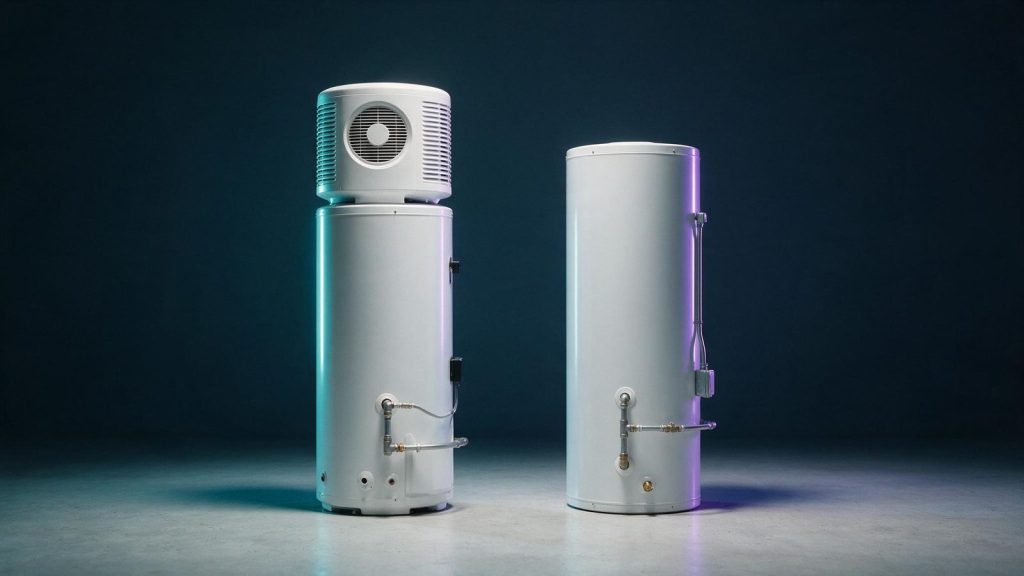
Two electric water heaters can stand side by side in the same aisle, run off the same house, deliver the same 120 °F water to the same shower, and differ by several thousand dollars over their working lives. That is the heat pump vs electric water heater question compressed into a sentence. Most appliance comparisons are close. This one is not.
The reason is arithmetic rather than preference. A resistance element turns one unit of electricity into one unit of heat and cannot do better, because that is the ceiling for the trick it performs. A heat pump does not make heat at all. It lifts heat out of the surrounding air and pushes it into the tank, three to four units for every unit of electricity it draws. Everything else about these appliances is a negotiation around that one number. If you are a step further back and still weighing storage against on-demand, the tank against tankless comparison comes first. If tankless is already on your shortlist, the heat pump against tankless comparison puts both on the same ten-year page.
The short answer
- All-electric house, garage or open utility room: heat pump, and the gap is not subtle. It repays the equipment difference inside three years at typical prices and then keeps paying.
- Cold, unheated basement up north: still the heat pump, but expect it to lean on its backup elements in winter, which stretches payback toward five years.
- Tight interior closet, no drain, no ducting: resistance tank. A heat pump in a sealed closet starves itself of the air it lives on.
- House you plan to sell inside two years: resistance tank. You will not hold the meter long enough to get the money back.
- Two adults, low hot-water use: heat pump still, but the saving scales with the load, so run your own kilowatt-hour rate through the arithmetic below.
One appliance makes heat, the other moves it
An electric resistance water heater is a bucket with a toaster in it. Current passes through a metal element, the element resists, and the resistance shows up as heat in the water around it. As a conversion it is close to lossless, which is why the Uniform Energy Factor of a resistance tank sits at 0.90 to 0.95 rather than 1.00. That shortfall is standby loss through the jacket overnight, not conversion loss at the element.
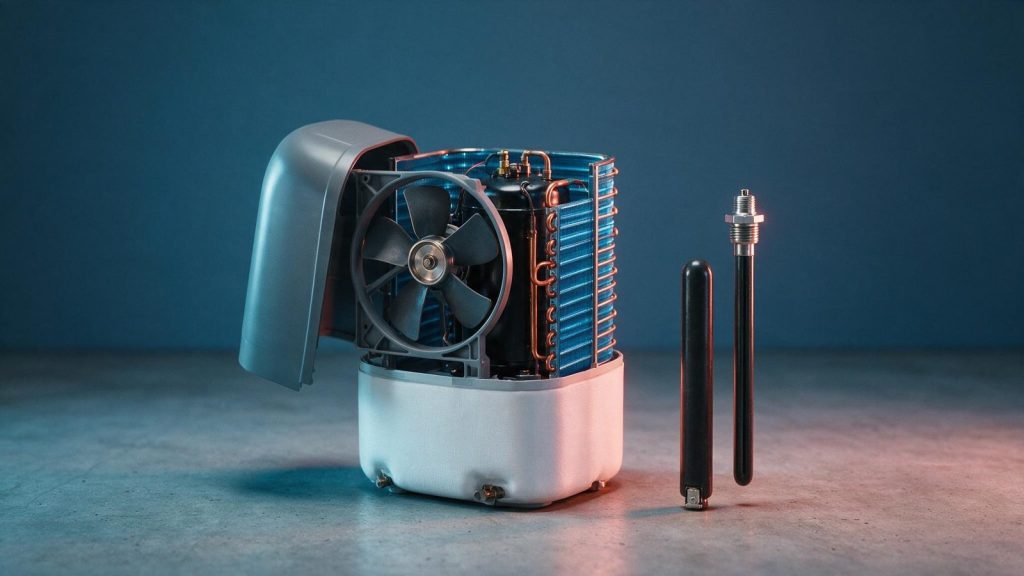
A heat pump water heater is a small air conditioner bolted to the top of a tank and run backwards. A fan pulls room air across an evaporator, refrigerant absorbs the low-grade heat already in that air, a compressor squeezes it up to a useful temperature, and a condenser hands it to the water. Nothing is converted. Electricity is spent relocating heat that was already sitting in your garage, which is why the UEF on the label reads 3.0 to 4.0 and looks like a printing error the first time you see it.
The catch hides in the same sentence. Heat that was sitting in your garage is heat that is no longer sitting in your garage. A heat pump water heater cools and dries the room it stands in, the way a dehumidifier does, which is more or less what it is. Benefit or cost depends on which room you put it in.
Side by side
| criteria | ELECTRIC RESISTANCE50 gal standard tank | HEAT PUMP50-65 gal hybrid |
|---|---|---|
| Typical UEF | 0.90-0.95ceiling is 1.00, by physics | 3.0-4.0moves heat instead of making it3.8x better |
| Electricity drawn for 4,000 kWh delivered | 4,348 kWh4,000 / 0.92 | 1,143 kWh4,000 / 3.53,205 kWh less |
| Energy cost per year | $739at $0.17 / kWh | $194at the same ratesaves $545 |
| Energy cost over ten years | $7,390no price escalation assumed | $1,940compressor running normallysaves $5,450 |
| Equipment price | $550-$900cheapest appliance in the categorycosts less | $1,500-$2,400before utility or state incentives |
| Payback on the price gap | n/ait is the baseline | 1 yr 1 mo – 3 yr 5 mobest case to worst caseclears fast |
| Rated lifespan | 8-12 yrtank corrosion ends it | 10-15 yrmore parts that can fail |
| Air it needs around it | Nonefits a closetgoes anywhere | ~700 cu ftor a ducting kit, per spec sheets |
| Effect on the room | Nonesilent, no drain neededinvisible | Cools and driesa gift in a humid garage, a tax under a bedroom |
| Condensate | Nonenothing to routesimpler | Needs a routegravity drain or a pump |
All-electric house with air around the unit and a drain nearby? Heat pump. The energy column decides it and nothing in the other columns is close enough to argue. Sealed closet, or a house you are selling? Resistance tank, without guilt.
The ten-year arithmetic, shown
Start with delivered heat, the one figure neither appliance can change. A household drawing 64 gallons a day at a 70 °F rise needs 13,637,568 BTU of heat put into the water every year, which is 4,000 kWh. Both machines have to produce it. What differs is what they consume doing so, and you get that by dividing delivered heat by the Uniform Energy Factor.
For a resistance tank at UEF 0.92: 4,000 / 0.92 = 4,348 kWh pulled through the meter. At $0.17 a kilowatt-hour, that is $739 a year. For a heat pump at UEF 3.5: 4,000 / 3.5 = 1,143 kWh, which comes to $194 a year. The difference is $545 every twelve months, and $5,450 across the ten-year window this site models.
Now stand the equipment price against that. A 50-gallon resistance tank runs $550 to $900, a 50 to 65 gallon heat pump $1,500 to $2,400. Take the harshest version, cheapest tank against dearest heat pump, and the gap is $1,850. At $545 a year of avoided electricity it closes in three years and five months. Take the gentlest, $900 against $1,500, and it closes in thirteen months.
The spread in heat pump performance does not rescue the resistance tank either. Run the same division at the bottom of the band, UEF 3.0, and input rises to 1,333 kWh and the bill to $227. At the top, UEF 4.0, it falls to 1,000 kWh and $170. The entire plausible range for a heat pump is $170 to $227 a year against $739 for the element. There is no version of this where resistance wins on energy. Not one.
Utility and state incentives, where offered, come straight off the equipment gap and in some territories erase it. They vary by utility, state and year, so I keep them out of the model rather than pretend a national figure exists. And to be clear on one point: the federal tax credit that used to apply to these units is not among your options. It expired on 31 December 2025.
What the heat pump takes back
Five real costs sit on the other side of that saving. Air volume comes first: manufacturer specification sheets typically ask for something on the order of 700 cubic feet of surrounding air, or a ducting kit instead, because the unit needs a reservoir of heat to draw from. A furnace closet does not have it. Noise comes second, at roughly the level of a window air conditioner, which is nothing in a detached garage and a family argument under a bedroom floor. Third, condensate. Pulling heat out of air pulls water out of it, and that water needs a drain or a pump. Fourth is the price on the box.
Fifth decides the northern cases, and it deserves its own arithmetic. Every hybrid unit carries resistance elements as backup and switches to them when the surrounding air gets too cold for the compressor. In an unheated Minnesota basement in February, the $2,000 appliance becomes the $700 appliance you were trying to avoid. Say it covers 40 percent of the year’s delivered heat on elements and 60 percent on the compressor: 0.4 x 4,000 / 0.95 is 1,684 kWh, plus 0.6 x 4,000 / 3.5 is 686 kWh. Total 2,370 kWh, or $403 a year. Still $336 better than the resistance tank, with payback stretching to about five and a half years at the harshest pairing. Degraded, not defeated. The operating modes behind that fallback are the subject of the hybrid pros and cons piece.
When I would still buy the plain electric tank
Three cases, and I will own them. A closet with no realistic route for air or condensate. A property you are listing this year. And the emergency: the old tank let go on a Friday, there is water on the floor, and the only unit anyone can get into the house today is the plain electric one. I would take the resistance tank on that Friday without a second thought. Living in a cold house for a week to protect $545 a year is a bad trade.
I keep meeting people who made a fourth choice, and it is the expensive one. They bought the cheapest tank on the shelf because the old one was leaking, never priced the alternative, then repaid the difference in monthly instalments for eleven years. At $545 a year that is close to $6,000 of electricity spent to sidestep a $1,200 decision made in four minutes under fluorescent light.
What I cannot tell you is which of the two lasts longer in your house. Storage tanks are rated at 8 to 12 years and heat pumps at 10 to 15, and the heat pump has more that can fail: a compressor, a fan, a control board, a condensate path. There is no public model-level failure database for water heaters in the United States. None. Anyone quoting a failure rate by model is quoting a plumber’s local sample or an affiliate page. The only published proxy is the warranty tier, worked through in what actually ends a water heater’s life.
Two things to settle before you shop
A heat pump recovers more slowly on the compressor alone than an element does, so the first-hour rating carries more weight here than with a straight electric tank. It is also why these units sell at 50, 65 and 80 gallons, not 40. Work your peak-hour demand through the sizing worksheet before you shop, because an undersized heat pump lives on its backup elements, and you have just seen what that costs.
The other is fuel. This article assumes an all-electric house, which is what makes the answer so lopsided. If there is already a gas line and a working flue, a straight gas tank swap is the cheapest replacement on the table and the heat pump has to overcome that head start. Different crossover, different article: heat pump against gas. One last thing that is not mine to answer: a heat pump may need panel capacity you do not have, which is a licensed electrician’s question.
Sources
- DOE Energy Saver, heat pump and electric resistance storage pages, for how each works.
- AHRI Directory of Certified Product Performance, for certified UEF values by model.
- ENERGY STAR certified product finder, for the UEF and first-hour rating bands used above.
- FTC EnergyGuide label, for the estimated annual energy cost printed on the unit.
- Manufacturer specification sheets and warranty documents, for surrounding-air requirement, ambient operating range, sound rating and condensate handling.
- US EIA, for the residential electricity price behind the $0.17 a kilowatt-hour used here.
The verdict is blunter than most because the numbers are further apart than most. If the house is all-electric, the unit will have air around it and a drain within reach, and you expect to still own the place in three years, buy the heat pump and stop researching. Each condition is checkable in an afternoon with a tape measure and a flashlight. The assumptions behind every figure above sit on the method page.
1 comment