
Ask which is better, a heat pump water heater vs tankless, and you have asked one question that is really two. A tankless unit sells you continuity and a reclaimed closet. A heat pump sells you a smaller electricity bill, and on that single measure nothing else sold for a house comes close. Put them on the same page and they look like rivals. Run the numbers and they turn out to be answers to different complaints.
What decides it, nine times out of ten, is not on either spec sheet. It is the fuel already at the property. Gas at the meter and a flue that draws, and a condensing tankless is the upgrade with the shortest path and a running cost that stays sensible. All-electric house, and the heat pump wins on money by a margin I would call embarrassing for everything else in the aisle. If you have not yet ruled out a plain storage tank, read the ten-year case for tanks against tankless first, because that comparison is cheaper to lose.
The short answer
- All-electric house, garage or basement with air to spare: heat pump, and it is not close. Roughly $194 a year of electricity against about $694 for an electric tankless, and nearer $740 for a resistance tank.
- Natural gas already piped to the house: condensing tankless. The heat pump’s energy advantage shrinks to around $21 a year, which never repays the price gap.
- Conditioned apartment or a tight mechanical closet: tankless. A heat pump wants room air by the hundreds of cubic feet, and it will chill and dry whatever space it stands in.
- Two teenagers, back-to-back showers, a house dry by 7:30 a.m.: tankless. A compressor recovers slowly, so a heat pump answers demand with stored gallons rather than speed.
- Unheated northern basement: think harder. Below roughly 40 °F of ambient air the heat pump drops onto its backup elements and becomes the electric tank it was bought to replace.
- Propane rather than natural gas: usually the heat pump, since propane per delivered therm rarely competes with a compressor running at three and a half times unity.
Heat pump water heater vs tankless: one makes heat, the other borrows it
A tankless heater is a heat exchanger with a burner or an element bank strapped to it. Water moves, it fires. Water stops, it quits. Nothing is stored, so nothing is lost standing still, and efficiency is capped by combustion. A condensing gas model squeezes a second pass of heat out of its own exhaust and reaches a UEF near 0.95. Above that is physics, not engineering budget.
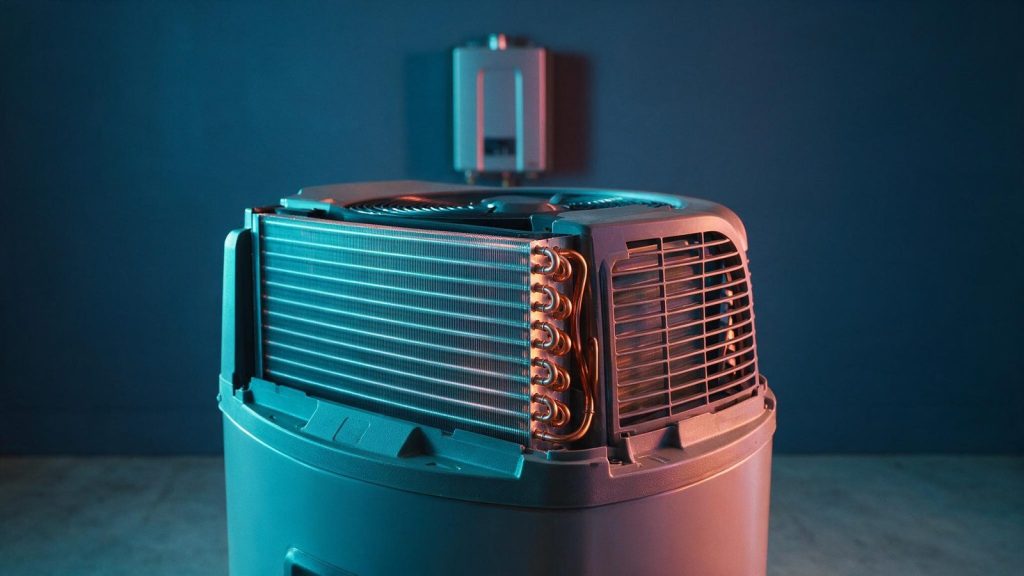
A heat pump water heater cheats that ceiling by not making heat at all. It is a storage tank with a small refrigeration circuit bolted to the top, running the same cycle as your fridge in reverse: pull warmth out of the room air, concentrate it, hand it to the water. Energy in, three to four times as much heat out. That is why UEF figures of 3.0 to 4.0 appear on the ENERGY STAR listings for these units, and why no burner ever built will match them. A burner has nowhere to borrow from.
The cost of that trick is the tank. A compressor heats water slowly, so the appliance stores 50 to 80 gallons to cover a morning rush. Which means the heat pump keeps the exact thing a tankless was bought to remove: a large cylinder on your floor, steel shell, sacrificial anode, same water-chemistry clock as any other tank.
Side by side
| criteria | HEAT PUMPhybrid, 50–65 gal | GAS TANKLESScondensing | ELECTRIC TANKLESSwhole-house |
|---|---|---|---|
| Typical UEF | 3.0–4.0moves heat, does not make itefficiency | 0.90–0.96second pass on the exhaust | 0.95–0.99no flue, no standby loss |
| Input for 4,000 kWh delivered | 1,143 kWh4,000 ÷ 3.5 | 143 therms136 ÷ 0.95 | 4,082 kWh4,000 ÷ 0.98 |
| Energy cost, ten years | $1,940at $0.17/kWhcheapest to run | $2,150at $1.50/therm | $6,940at $0.17/kWh |
| Equipment price | $1,500–$2,400unit only | $1,000–$2,000unit only | $500–$900cheap box, costly to feedlowest sticker |
| Expected service life | 10–15 yrtank and anode set the clock | 15–20 yrconditional on descalinglongest | 15–20 yrfewer parts to fail |
| Long draw behaviour | Finitestored gallons, slow recovery | Continuousflow-limited by risenever runs out | Continuousflow limit is severe in cold climates |
| Effect on its room | Cools & driesplus compressor noise for hours | Nonebrief fan noise onlyneutral | Nonesilent in operation |
| Space claimed | Tank + airneeds clearance and room volume | Wall-hungfrees the floorsmallest | Wall-hungsmaller still, no flue |
Gas at the meter? Tankless, and spend the difference on a condensing model rather than on a compressor you do not need. All-electric house? Heat pump, and the gap over any instantaneous electric unit is roughly five thousand dollars a decade.
Ten years of energy, divided out
A household drawing 64 gallons a day at a 70 °F rise needs about 4,000 kWh a year of heat actually delivered into the water. That figure is the same whatever appliance you buy. It is heat in the tub and the sink, before any machine has wasted a thing. Divide it by the appliance’s UEF and you get what you are billed for.
The heat pump, at a UEF of 3.5: 4,000 ÷ 3.5 = 1,143 kWh a year. At $0.17 that is $194 a year, or $1,940 over ten years. A whole-house electric tankless, at 0.98: 4,000 ÷ 0.98 = 4,082 kWh, which is $694 a year and $6,940 over ten. Same hot water, same house, a difference of $5,000. That is not a preference. That is the compressor doing work an element cannot do.
Gas changes the picture completely. Those 4,000 kWh of delivered heat are about 136 therms. A condensing tankless at 0.95 burns 136 ÷ 0.95 = 143 therms, which at $1.50 is $215 a year and $2,150 over ten. A non-condensing unit at 0.82 burns 166 therms, so $249 a year and $2,490. Set that against the heat pump’s $1,940 and the ten-year advantage is $210, or $550 against the non-condensing model. The heat pump costs several hundred more to buy, wants floor space and steals warmth from the room. For $21 a year I would not do it, and I keep meeting people who did because a salesperson called it the efficient choice and never asked whether they had gas. Choosing between the two tankless grades is its own break-even calculation.
One correction, because showrooms still repeat it: the federal 25C tax credit for heat pump water heaters expired on 31 December 2025. Do not build a payback model on it. Utility and state incentives, where offered, are worth checking, and they vary enormously by territory.
The heat pump takes something out of the room
Here is the trade nobody puts on the sticker. The warmth the compressor moves into your water comes from the air around the unit, so the appliance exhales cold, dry air for as long as it runs. In a Houston garage in August that is a gift, and the dehumidification alone will be welcome. In a finished Minneapolis basement in February it is a tax, because your furnace is paying to make the heat your water heater keeps stealing back.
Noise is the second one. A compressor and a fan run for hours at a stretch, in the sound class of a window air conditioner. A tankless makes a brief fan noise when a tap opens, then goes silent. If the mechanical space sits under a bedroom, that difference will matter more than $21 a year ever will. Manufacturers also specify a minimum room volume, commonly several hundred cubic feet, or ducting instead, and there is a condensate line to think about, since pulling heat out of air wrings water out of it too. Panel capacity is a real consideration as well, and a question for a licensed electrician rather than a website.
The cold-space case deserves its own warning. Every hybrid carries resistance elements as a backup, and in a space that drops toward 40 °F the controls hand the job to those elements. At that point you own a $1,900 electric tank running at UEF 0.9, which is the appliance the purchase was meant to avoid. That backup behaviour is the single most misunderstood thing about these units, and it is covered properly in the hybrid pros and cons.
The lifespan mismatch that ten years hides
A ten-year model flatters the heat pump. At year ten the heat pump is near the end of its quoted 10 to 15 years and a tankless, quoted at 15 to 20, is barely halfway through. Run it over twenty years instead and you buy roughly two heat pumps against one tankless, so the running-cost advantage has to carry a whole extra appliance before it counts.
Both bands carry conditions. The tankless figure assumes the heat exchanger gets descaled on schedule, roughly annually in hard water and every two or three years in soft, and an unmaintained unit will not see fifteen. The heat pump’s tank runs on a different clock, the anode-and-water-chemistry clock that governs any steel tank.
And now the thing I cannot tell you, which no page on the internet can. There is no public, model-level failure database for water heaters in the United States. Nobody publishes how often a given compressor packs up in year seven, or how many tankless control boards die in year nine. The bands above are industry and manufacturer figures, not measured field data, and anyone quoting a failure rate to two decimal places is quoting their own plumbing van. The closest thing to a published reliability signal is the warranty term, because that is the manufacturer betting its own money. Read it before the brochure.
Where each one is the wrong buy
My own rule fails in two specific places, so let me name them. Gas at the house means tankless, except in a house with genuinely small hot water demand, where a light user never burns enough therms for any efficiency argument to pay and a modest storage tank is the honest answer. It breaks the other way too. A large all-electric household with a real morning peak can outrun a single heat pump’s recovery, and no running-cost advantage fixes a cold shower at 7:15.
Both are sizing problems rather than appliance problems, which is why the arithmetic belongs before the purchase. Sizing a tankless unit is flow times rise, and the rise half moves the answer hardest, because the same box behaves very differently on 42 °F groundwater than on 70 °F.
Sources
- US Department of Energy, Energy Saver: heat pump and demand-type water heaters, including ambient-temperature limits.
- ENERGY STAR certified product finder: UEF and first-hour-rating listings for residential heat pump units.
- AHRI Directory of Certified Product Performance: certified UEF and rated capacity, storage and instantaneous.
- FTC EnergyGuide label: estimated annual energy use, and the assumptions behind it.
- Manufacturer specification sheets and warranty documents: minimum room volume, ambient range, flow-versus-rise curves, warranty terms.
- US Energy Information Administration: residential gas and electricity prices, used to sanity-check our constants.
Strip the marketing off both and the choice gets simple. Tankless is a delivery upgrade: continuous hot water, a wall instead of a floor, a longer replacement cycle. The heat pump is a running-cost upgrade, and against electric resistance it is the largest efficiency gain sold for a house. Buy the one that fixes your actual complaint, and let the fuel at your meter break the tie. Every figure above comes from the same published assumptions, and you can read how they are built on our method page.