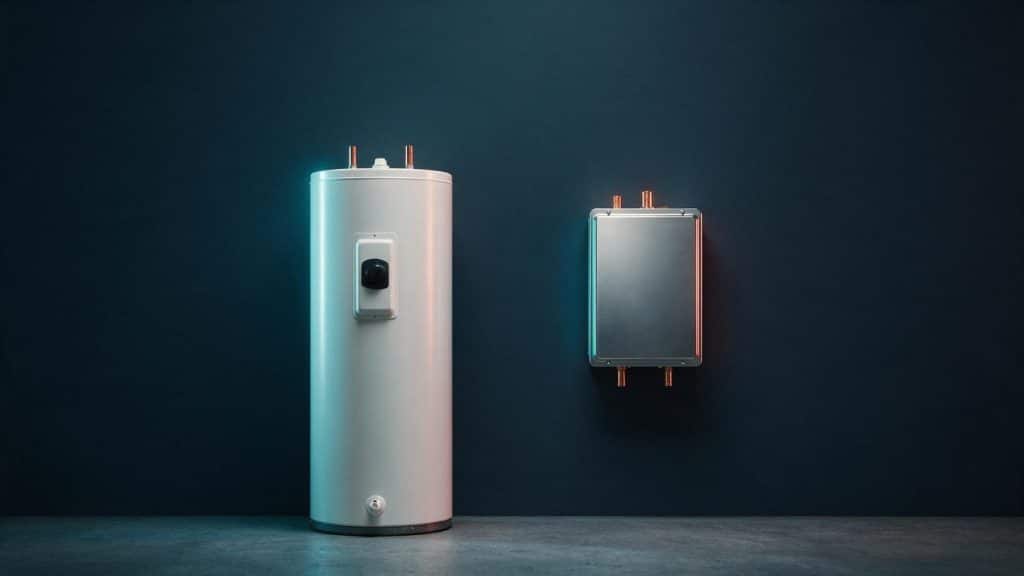
A storage tank and a tankless unit do the same job in opposite ways. One keeps 50 gallons hot around the clock so it is ready when you are. The other heats nothing until you open a tap, then heats hard. Everything people argue about downstream of that, the efficiency, the running cost, the day it dies, follows from that one difference. If the verdict below lands on tankless, the best tankless water heater guide takes the next step: which unit your groundwater and gas meter will actually allow.
Most comparisons stop at “tankless is more efficient.” That is true and it is not the whole answer. Over ten years, on a gas house, the gap is smaller than the marketing suggests. On an all-electric house in a cold climate, tankless can be the wrong appliance entirely. Below is the arithmetic, with every assumption printed so you can change one and see what happens. For the five usual tankless claims tested one at a time, see tankless water heater pros and cons.
The short answer, by household
- Gas available, 2 to 4 people, replacing a dead tank: gas tankless, if you are staying in the house past year twelve. If you might move sooner, buy the tank.
- All-electric house, cold winters (northern half of the US): not tankless. Electric tankless cannot make enough hot water at 40 degree inlet temperature. Buy a heat pump water heater, or a resistance tank if the space is too cold or too small.
- All-electric, warm climate, one or two people: electric tankless works, and it is the one case where it comfortably beats a resistance tank.
- Five or more people, several showers at once: a large tank with a high first-hour rating, or two tankless units. One tankless unit will disappoint you at 7 a.m.
- Vacation home, guest house, anything used a few weeks a year: tankless. Standby loss on an idle tank is the whole running cost.
- Tight budget, need hot water tomorrow: tank. It is half the equipment price and it does not need new venting or new electrical capacity.
What each one actually is
A storage water heater is an insulated 30 to 80 gallon tank with a burner underneath or two elements inside. It holds water at your set temperature, usually 120 degrees, and it reheats whenever the thermostat drops. When you drain it faster than it reheats, you run out and you wait. Gas versions of that tank still need to vent their exhaust somewhere, and whether that vent is direct or powered depends mostly on the room.
A tankless unit is a heat exchanger with a flow sensor. Open a hot tap, it fires, and it heats water as it passes through. It never runs out, which is the headline. What it does instead is run out of flow: it can only raise a certain number of gallons per minute by a certain number of degrees, and that ceiling is fixed by physics, not by the brand.
The numbers, side by side
| criteria | Gas storage tank50 gallon | Gas tanklesscondensing, 199k BTU | Electric tankless27 kW whole house |
|---|---|---|---|
| Equipment price | $700–$1,300Widely stockedcheapest | $1,100–$2,000Condensing models at the top | $600–$1,200Unit only, before panel work |
| Efficiency (UEF) | 0.58–0.70Flue and standby losses | 0.87–0.96Condensing recovers flue heatbest gas | 0.97–0.99No flue, nothing to lose |
| Annual energy cost | $319213 therms | $220147 therms−31% | $6934,078 kWh |
| Hot water on tap | 50 gal, then waitRecovers 40–50 gal/hr | 4.8 GPM, foreverAt 70°F risenever runs out | 2.6 GPM, foreverAt 70°F rise. One shower. |
| Service life | 10–13 yearsAnode and tank corrosion | 20+ yearsParts are replaceablelongest | 15–20 yearsElements are replaceable |
| Floor space | ~5 sq ft60 in tall, 20 in wide | NoneWall mounted, shoebox sizedfrees a closet | NoneSmaller than the gas unit |
| What it demands of the house | LittleReuses existing gas line and fluesimplest swap | A lotLarger gas line, new sealed vent | The mostOften more capacity than a 100-amp panel has |
| How it fails | It leaks50 gallons onto the floor | It stopsError code, cold showers, no floodno water damage | It stopsSame, no flood |
| Ten-year total | $4,090Unit + energy | $3,700And half its life still aheadlowest gas | $7,830Electricity dominates |
Gas in the house and staying put? Condensing tankless. It is $390 ahead at year ten and it is only halfway through its life. Gas but moving in a few years? Tank. You will never see the payback. All electric? Neither of these two. The number that matters on an electric house is $693 a year, and a heat pump water heater cuts it to about $194.
Ten-year cost of ownership, with the assumptions on the table
Every running cost above comes out of one model. Here it is, so you can argue with it.
- Household of three to four people, 64 gallons of hot water a day.
- Incoming water at 55 degrees, delivered at 125 degrees. A 70 degree rise.
- That is 37,400 BTU a day, or 13.6 million BTU a year, before any losses.
- Natural gas at $1.50 per therm. Electricity at $0.17 per kWh.
- Equipment prices are midpoints of national retail. Installation is not in these numbers. Labor is local, it varies by a factor of three across the country, and anyone quoting you a national figure for it is guessing.
Run those numbers and the gas storage tank burns 213 therms a year, the condensing tankless burns 147. At $1.50 a therm that is $99 a year of difference, or $990 over ten years. The tankless unit costs roughly $600 more to buy. So it pays itself back somewhere around year six or seven on equipment alone, and then it keeps going for another decade after the tank would have been replaced.
That last clause is the part most comparisons skip, and it is the one that decides the argument. At year ten the tank is at the end of its life and the tankless is halfway through its own. If you plan to sell in year five, none of this reaches you.
| Ten years, one house | Gas tank | Gas tankless | Electric tank | Electric tankless | Heat pump |
|---|---|---|---|---|---|
| Equipment | $900 | $1,500 | $800 | $900 | $1,900 |
| Energy, 10 years | $3,190 | $2,200 | $7,390 | $6,930 | $1,940 |
| Total | $4,090 | $3,700 | $8,190 | $7,830 | $3,840 |
| Life left at year 10 | None | 10+ years | 1–3 years | 5–10 years | 3–5 years |
The uncomfortable line in that table is the electric one. On an all-electric house the choice of tank or tankless moves the ten-year cost by about 4 percent. Switching to a heat pump water heater moves it by more than half. If your house has no gas, the tank-versus-tankless question is the second most important one you can ask.
Where tankless quietly fails
Cold ground water eats the flow rate
A tankless unit’s rating is meaningless without a temperature rise attached to it. The same appliance that delivers 7.5 GPM in Houston delivers under 5 GPM in Minneapolis, because in January the water arriving at the house is 40 degrees instead of 70.
The arithmetic is simple enough to do on a napkin. Flow in gallons per minute equals the burner’s output in BTU per hour, times efficiency, divided by the temperature rise times 500. A 199,000 BTU gas unit at 90 percent efficiency, asked for a 70 degree rise, gives you about 4.8 GPM. Two 2.1 GPM showers fit inside that. Add the kitchen sink and it does not.
Electric is where this turns brutal. A 27 kW whole-house unit is 92,000 BTU per hour. At a 70 degree rise that is 2.6 GPM. One shower, and nothing else. In Florida, at a 45 degree rise, the same unit gives 4 GPM and behaves like a real water heater. The unit did not change. The climate did.
The cold water sandwich
Turn a tap off and back on within a minute or two and you get a slug of cold water between two hot ones. It is the water that sat in the pipe while the burner was off. Recirculation buffers help, at the cost of some of the efficiency you bought the thing for. It is a small annoyance that people either never notice or never stop noticing.
Hard water is a recurring bill
Scale builds on the heat exchanger, output drops, and eventually the unit throws an error. Above roughly 7 grains per gallon of hardness, a tankless unit needs descaling every year and most warranties assume you are doing it. A tank tolerates hard water badly too, but it fails slowly and silently instead of announcing itself. Budget for this or soften the water.
Where tanks quietly fail
Standby loss is the obvious one: you pay to keep 50 gallons hot through every hour you are at work or asleep. On a modern insulated tank it is smaller than it used to be, but it never reaches zero, and it is the entire reason a rarely used building should not have a tank at all.
The failure mode is the real argument. A tank does not stop working, it opens. Fifty gallons arrive on the floor, usually at the lowest point of the house, usually while nobody is home. Every plumber I have spoken to tells the same story about the finished basement. A tankless unit that fails just stops making hot water, which ruins a morning rather than a floor.
And a tank runs out. Fifty gallons at 120 degrees, mixed down to a 105 degree shower, is roughly 70 gallons of usable shower water, then a 40 to 50 gallon per hour drip feed. Three long showers back to back is the practical ceiling. Whether that matters is a question about your family, not about the appliance, and it is the reason the first-hour rating is worth more of your attention than the gallon number on the label.
Deciding in five minutes
- Do you have natural gas at the house? If no, skip to step 4.
- Will you own the house in twelve years? If yes, condensing tankless. If no, tank.
- Do two showers ever run at the same time in winter? If yes, check the unit’s flow at your actual temperature rise before you buy, not its headline number.
- All electric? Price a heat pump water heater first. Consider electric tankless only if you are one or two people in a warm climate.
- Whatever you pick, size it. A correctly sized tank beats an undersized tankless every morning of the week.
Once the type is settled, capacity is the next decision, and it is the one people get wrong most often in both directions. Our sizing guide has an interactive tool and the peak-hour worksheet behind it. If you already know the size and you are down to picking a badge, the two brands that own most of the American market are compared in Rheem vs A.O. Smith.
Sources and how these numbers were built
- US Department of Energy, Energy Saver: tankless units are 24 to 34 percent more efficient than storage for homes using 41 gallons a day or less, and 8 to 14 percent for homes using around 86 gallons. Our 64 gallon household sits between those two, and the model lands where it should.
- Uniform Energy Factor ratings come from the AHRI directory and manufacturer spec sheets, not from marketing pages. Any UEF you see quoted without a model number attached is worth nothing.
- ENERGY STAR certified product lists for the heat pump water heater efficiency range.
- Fuel prices are national residential averages and they are the assumption most worth changing for your own state. At $0.11 per kWh the electric column looks very different.
Federal tax credits are not in this math. The 30 percent federal credit for heat pump water heaters under Section 25C expired on December 31, 2025. Utility and state rebates still exist in many places and can be worth several hundred dollars, so check your own utility before you buy. Our method page explains how we build these models and what we refuse to publish.
4 comments