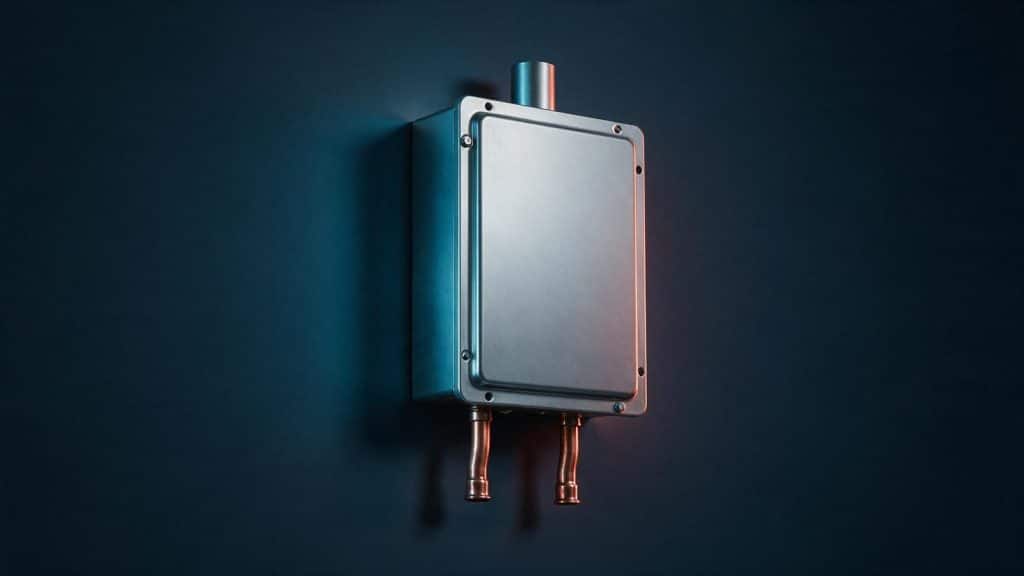
Most lists of tankless water heater pros and cons read like they were assembled from other lists. The pros are real, all five of them. Every one also carries a condition attached, and the conditions are where the money and the disappointment actually live.
So here is the same list, checked against a house instead of a brochure. A tankless unit does not store hot water. It makes it while you draw it, and that swaps one constraint for another: you stop asking how many gallons are left and start asking how many gallons a minute you can pull. That second question has a different answer in Duluth than it does in Fort Myers, which is the single most under-explained thing about these appliances. If you want the broad appliance-against-appliance case first, the ten-year verdict on tanks against tankless covers it. This page is narrower. It takes each claim and tests it.
The short answer
- Two adults, gas already at the meter, moderate climate: the pros survive the test. A condensing unit beats a gas tank on fuel by about $99 a year at our constants, and it lasts roughly twice as long.
- Northern tier, two showers running at once: size for the temperature rise or the headline pro turns into the headline complaint. Incoming water near 42 °F costs a unit about a third of its usable flow against the same box in Florida.
- All-electric house with no gas line: whole-house tankless is the wrong shortlist entirely. A heat pump takes the running-cost argument and it is not close.
- Hard water and no softener: the twenty-year life is conditional, and the condition is descaling. Skip it and you have bought a shorter-lived appliance at a higher price.
- Tank leaking on the floor right now: buy the tank. Tankless is a planned purchase, not an emergency one.
Every pro on the list rests on one number
A burner has a fixed output. Water leaving the unit is that output shared out across however hard you are working it, which gives one piece of arithmetic that quietly decides everything else: gallons per minute equals the burner’s heat output divided by the temperature rise, times 500.
Run a real unit through it. A 199,000 Btu per hour condensing model at a UEF near 0.95 puts about 189,000 Btu an hour into the water. South Florida groundwater sits around 70 °F, so reaching a 120 °F tap is a 50-degree rise: 189,000 ÷ (50 × 500) = 7.6 gallons a minute. Minnesota groundwater runs closer to 42 °F, a 78-degree rise: 189,000 ÷ (78 × 500) = 4.8 gallons a minute. Same box. Same badge. Same price on the shelf. A shower pulls somewhere between 1.8 and 2.5 GPM, so the Florida house runs three of them and the Minnesota house runs two and nothing else. The tankless size chart gives the fixture flows and the burner size each climate needs.
This is why “endless hot water” is true and misleading in the same breath. There is no tank to empty, so a single long shower never goes cold. But the ceiling on how much you can draw at once is hard, and it moves with the seasons and the latitude. The number printed on the carton is quoted at a flattering rise. Read the manufacturer’s flow-against-rise curve instead, and if you are shopping rather than browsing, work through how to size a tankless unit for your own climate before you compare anything else.
Tankless water heater pros and cons, side by side
| criteria | GAS TANKLESScondensing, 199k Btu | GAS STORAGE TANK50 gal, UEF 0.65 |
|---|---|---|
| One long draw | No limitwithin its flow ceilingnever runs out | ~35 galusable, then recovery |
| Simultaneous flow | 4.8–7.6 GPMset by groundwater temperature | FHR 70–90 galfirst hour only, no climate penaltysteadier ceiling |
| Ten-year fuel | $2,150136 therms ÷ 0.95$990 less | $3,140136 therms ÷ 0.65 |
| Equipment price | $1,000–$2,000condensing at the top of the band | $700–$1,300cheapest box on the shelflower entry |
| Rated life | 15–20 yrconditional on descalingone purchase, not two | 8–12 yranode and water chemistry set the clock |
| Minimum flow to fire | 0.4–0.5 GPMbelow it you get cold water | Noneany trickle is hotno threshold |
| Short repeat draws | Sandwichhot, cool slug, hot again | Steadystorage buffers itno surprise |
| Footprint | Wall-hungthe tank’s floor space comes backspace returned | 20 in × 5 ftneeds a closet, corner or garage wall |
Gas at the meter and staying put a decade? The tankless case holds together on fuel and on lifespan. Cold groundwater and two simultaneous showers? Size for the rise or buy the tank, because an undersized tankless is worse than the appliance it replaced.
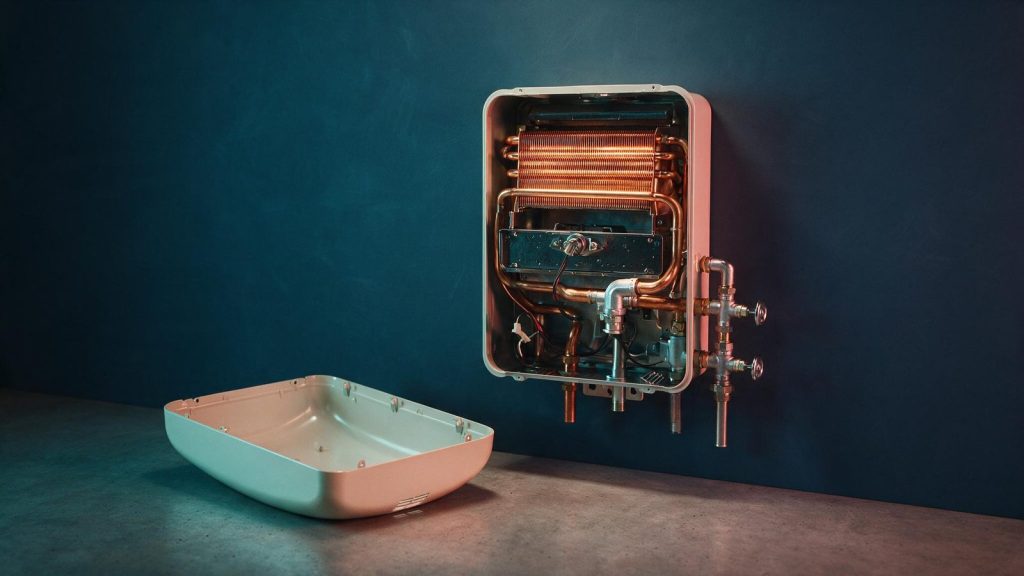
The fuel saving, worked out
A household drawing 64 gallons a day at a 70-degree rise needs about 4,000 kWh of delivered heat a year, which is roughly 136 therms of actual heat sitting in the water. Divide that by the unit’s UEF and you get what the meter reads.
A gas storage tank at UEF 0.65 burns 136 ÷ 0.65 = 209 therms, or $314 a year at $1.50. A non-condensing tankless at 0.82 burns 136 ÷ 0.82 = 166 therms, $249 a year. A condensing tankless at 0.95 burns 136 ÷ 0.95 = 143 therms, $215 a year. Over the ten-year window that is $3,140, $2,490 and $2,150, so the tankless saving against a tank lands between $650 and $990 depending on which side of the condensing line you buy.
The equipment gap runs the other way. Gas tankless sits at $1,000 to $2,000, a 50-gallon gas tank at $700 to $1,300, so call it $500 of extra hardware at the midpoints. The fuel saving clears that comfortably at the condensing end and clears it more slowly at the non-condensing end. What this arithmetic leaves out is the fitting, and it is the biggest thing it leaves out. That work is local, priced locally, and I am not going to pretend a national number for it exists.
The pro nobody sells hard enough
Ask ten people to name the advantage and nine say endless hot water. The one that actually changes household economics is duller: the replacement cycle. A storage tank is rated at 8 to 12 years and a tankless unit at 15 to 20, which means that across a twenty-year stay in the house you buy the tank twice and the tankless once. On equipment alone that is $1,400 to $2,600 of tanks against $1,000 to $2,000 of tankless, and every one of those replacements also carries a day of somebody’s labour that I am deliberately not quoting.
There is a real condition on that figure and it is scale. Hardness above roughly 10 grains per gallon deposits minerals on a heat exchanger, the exchanger loses efficiency, and eventually the unit throws a fault instead of hot water. Descaling is the fix, annually in hard water and every two or three years in soft. It needs doing. That is as far as this site goes on the subject, because it is maintenance work and there is a longer piece on what actually determines a tankless unit’s lifespan.
Now the concession, and it is a big one. Fifteen to twenty years is a rated life drawn from manufacturer documentation and warranty terms, not a measured survival curve. There is no public model-level failure database for water heaters in the United States. Nobody publishes one, not the manufacturers and not any regulator, so anybody quoting you a failure rate by model is quoting their own service van. The warranty length is the closest thing to a manufacturer’s own bet on the hardware, and it is worth more than a forum thread.
I would not pay the tankless premium for a house I expected to sell inside four years. The lifespan advantage is the strongest card in the deck and it only pays out to whoever is still living there.
The con nobody leads with
Two of them, actually, and neither appears in the marketing. The first is the cold-water sandwich. Close the tap and the burner stops, but the water already inside the exchanger and the pipe run keeps its heat for a while and then loses it. Open the tap again a minute later and you get a brief slug of warm, then a noticeably cool patch, then hot. It is a nuisance in a shower and a genuine irritation at a kitchen sink where draws are short and repeated. Recirculation hardware smooths it out, and it adds cost and a small standby energy penalty to an appliance bought partly to avoid standby losses.
The second is the minimum activation flow, typically somewhere around 0.4 to 0.5 gallons a minute on the manufacturer’s spec sheet. Below that threshold the unit will not fire at all. A gently opened bathroom tap, a low-flow aerator on a partly closed shutoff, a slow trickle for shaving: none of these light the burner, and the water simply stays cold with no explanation offered. A tank has no such threshold, which is the sort of thing you never notice until it is gone.
While we are deflating things, the space claim deserves a harder look. A tankless unit hangs on a wall and gives back a footprint of roughly 20 inches across and five feet tall. In a city condo where floor area has a dollar value that is a genuine benefit. In a two-car garage in Phoenix it is worth nothing at all, and I keep meeting people who paid several hundred dollars extra for square footage they were never going to use. And if the house has no gas service, whole-house electric tankless is a different animal with a constraint of its own, and the constraint is the electrical service it asks for rather than the flow it can heat.
The fifth claim on every list is that there is nothing left in the house to flood it with, and that one mostly survives the test. A storage tank ends its life by leaking, and it does that with fifty gallons in it, usually onto whatever the floor is made of. A tankless unit holds a cup or two of water at any moment, so its bad day is a fault code and a cold shower instead of a wet basement. Mostly. Fittings and valves still leak, and a wall-hung unit still hangs over the same floor, so the difference here is one of scale rather than of kind.
Sources
- DOE Energy Saver, tankless and demand-type water heater guidance, for the operating principle and the flow-limit framing.
- AHRI Directory of Certified Product Performance, for certified UEF values and rated flow at stated temperature rises.
- ENERGY STAR certified product finder, for the efficiency bands used in the condensing and non-condensing comparison.
- FTC EnergyGuide label, for the annual energy cost basis printed on storage units.
- Manufacturer specification sheets and warranty documents, for minimum activation flow, flow-against-rise curves, descaling intervals and rated life.
- US Energy Information Administration residential price series, as the sanity check on the $1.50 therm and $0.17 kilowatt-hour used here.
Checked one at a time, all five pros survive, and every one of them comes back with a condition attached. That is a better result than most appliance marketing survives. The honest summary is that a tankless unit is a good buy for a house with gas at the meter, a moderate climate or a properly sized unit for a cold one, and an owner who intends to still be there in ten years. Everyone else is buying a premium for a benefit they will not collect. Every figure above comes out of the same published constants and the same arithmetic, which are laid out on our method page so you can substitute your own utility rates and watch the answer move.