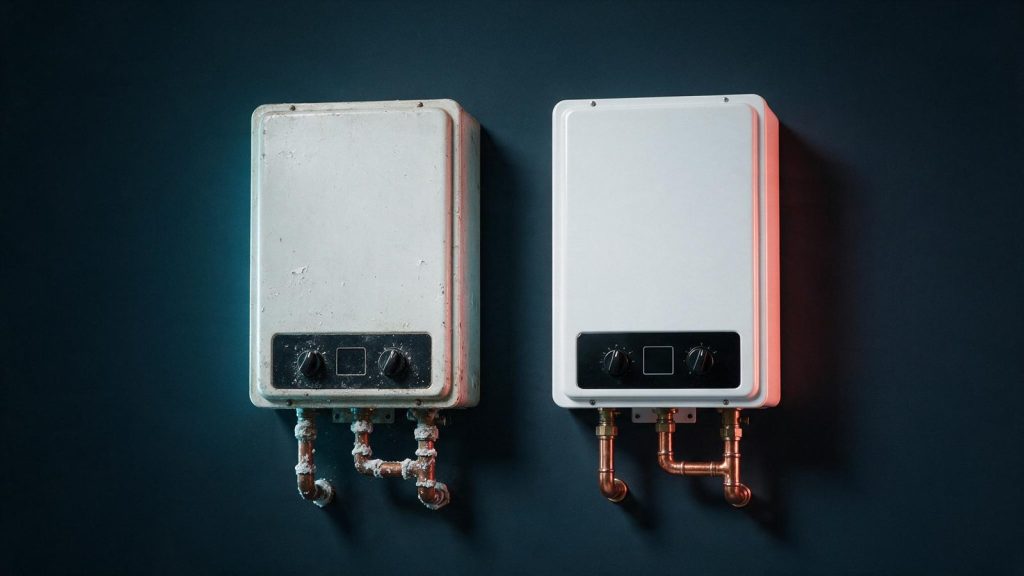
The stock answer to how long does a tankless water heater last is fifteen to twenty years, and unusually for a stock answer, it is close to right. These units do outlive storage tanks, usually by about double. What the brochure leaves out is that the number is conditional, and the condition is not measured in years. It is measured in grains per gallon.
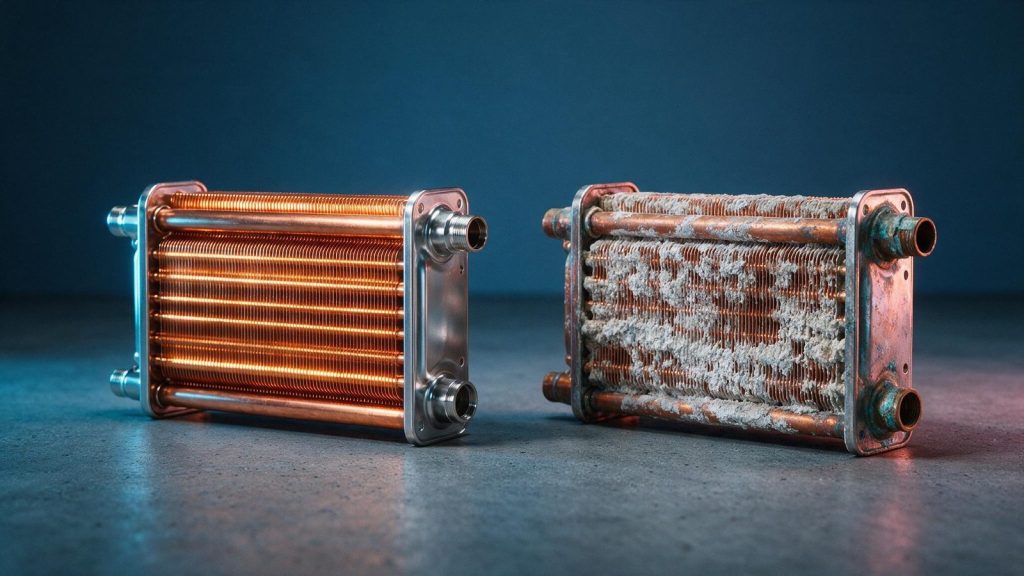
A tank heats water in a wide steel drum and puts up with a surprising amount of mineral sitting on the bottom of it. A tankless unit heats water in a narrow passage inside a copper or stainless heat exchanger, and the mineral a tank simply ignores plates onto the walls of that passage instead. Keep the descaling interval and fifteen to twenty years is a plan you can budget on. Miss it in hard water and the exchanger decides when the unit stops, years short of that. There is a second half almost nobody leads with, and it changes what the word lifespan even means: when a tankless unit quits, it usually quits in a way a part can fix, and a leaking tank cannot be fixed by anybody. We ran the same question for storage tanks separately, where the clock is the anode rather than the exchanger, and the ten-year money comparison between the two appliances sits alongside it.
The short answer
- Soft water, under about 3 grains per gallon: twenty years is realistic and the service can stretch to every two or three years. This is the household the brochure was written for.
- Hard water at 10 to 15 grains, descaled on schedule: still fifteen years or better, but the yearly service is not optional and the warranty says so in writing.
- Hard water, never serviced: plan for tank-like life, eight to twelve years, and a heat exchanger claim the manufacturer is entitled to decline. You paid tankless money for tank life, and this is how the twenty-year figure usually fails.
- A whole-house softener already fitted: treat the house as soft water whatever the utility report says, and plan on the long end.
- Moving inside five years: lifespan is not your argument. Buy on flow rate, running cost and space, and let the next owner inherit the schedule.
What hardness actually does to a heat exchanger
Hardness is dissolved calcium and magnesium, counted in the US in grains per gallon. One grain per gallon means 64.8 milligrams of mineral in that gallon, about 17.1 milligrams per litre. Under about 3 grains the water is soft. Above about 7 it is hard by any definition, and supplies across Arizona, Texas, Florida and the upper midwest commonly run past 15 grains, with parts of the southwest higher still. Your utility publishes the figure in its annual water quality report. Look it up before you shop, not after.
Now put a household through it. At the 64 gallons a day this site models, a house pushes 23,360 gallons through the unit in a year. At 10 grains per gallon each of those gallons carries 648 milligrams of dissolved mineral, so the annual load moving through a heat exchanger the size of a shoebox is about 15 kilograms. Thirty-three pounds. Almost all of it leaves with the water, and the small fraction that does not is the fraction that sets your lifespan. Calcium carbonate drops out of solution fastest where the water is hottest, which is the wall of the passage the burner is heating.
The deposit does two things, neither dramatic on any single day. It insulates the wall, so the unit fires harder to hit the same set point and the metal behind the scale runs hotter than it was designed to. And it narrows the passage, so flow drops and the temperature control starts to hunt. Nothing breaks. The unit just gets worse at its job, year after year, until it reports a fault and somebody works out the exchanger is the problem. A high set temperature accelerates all of it, which is one reason the same model lasts differently in two houses on the same street.
Manufacturers know it and they write it down. Residential tankless warranty documents commonly carry a water quality condition: treatment above a stated hardness, periodic descaling, and the right to decline a heat exchanger claim if neither happened. Read that clause before you read the GPM figure on the box. It is the manufacturer naming the maintenance interval it has priced into its own risk, which beats any marketing page for honesty. The manuals put that interval at once a year as a baseline, stretching to two or three in soft water and tightening in the worst supplies. That is as far as this goes. We do not publish maintenance procedures, and how quick the job is on your unit depends mostly on whether it was fitted with service valves.
Side by side: two different kinds of ending
The row that matters below is not the lifespan row. It is the one about what ends the appliance, because these two do not fail the same way, and that is why comparing their lifespans as two plain numbers misleads.
| criteria | STORAGE TANKgas, 50 gallon | TANKLESSgas, condensing |
|---|---|---|
| Published service life | 8–12 yrshorter in hard water | 15–20 yrconditional on descalingwin |
| What ends it | A leakpinhole through the steel shell | A componentscale, board, fan or valve |
| Repairable at end of life | Noa leaking tank is scrap that day | Usuallymost failures have a part numberwin |
| The clock that runs it | Anodesacrificial rod, then the steel | Scalehardness, set point, hours of use |
| Warranty on the pressure part | 6–12 yrtiered by anode arrangement | 12–15 yrheat exchanger, conditions attachedwin |
| Equipment cost per year of service | $100$1,000 midpoint ÷ 10 years | $86$1,500 midpoint ÷ 17.5 yearswin |
| Units bought in 20 years | 2on the 10-year average | 1if the service interval holdswin |
| Service the lifespan depends on | Anode checkevery few years, rarely done | Descaleyearly baseline, warranty condition |
Hard water and nobody who will book a service? The tank’s shorter life is at least honest, and the tankless promise is not yours to spend. Soft water, or a softener already in the house? One tankless unit outlives two tanks and the rest of the arithmetic follows from that.
How long does a tankless water heater last in money terms
Lifespan only earns its keep once you turn it into a replacement cycle, so here is the twenty-year window with the arithmetic on the page. Start with delivered heat, the part that does not change between appliances. Sixty-four gallons a day, 365 days, 8.34 pounds a gallon, raised 70 °F, is 13,637,568 BTU a year. Call it 136 therms that have to end up in the water no matter what is making them.
Input energy is delivered heat divided by the appliance’s UEF, and that division is the whole model. A gas storage tank at 0.65 burns 136 ÷ 0.65 = 210 therms a year. A condensing tankless at 0.93 burns 136 ÷ 0.93 = 147 therms. At $1.50 a therm that is $315 against $220, a gap of $95 a year, or $1,900 across twenty years. Now the hardware. Two tanks at a $1,000 midpoint is $2,000 of equipment across that window; one tankless at a $1,500 midpoint is $1,500. Add the two lines and the tankless is roughly $2,400 ahead over twenty years, on equipment and gas alone.
Two caveats on that figure. It is equipment only. Installation is local pricing, it is not the same job for the two appliances, and we do not model it. And it assumes the tankless unit reaches year twenty, which is precisely the assumption the descaling interval protects. Take five years off and you buy a second unit inside the window, which erases the equipment advantage and leaves you the $1,900 of gas savings and a service bill. How big the efficiency half of that gap is depends on which unit you buy, and the condensing against non-condensing arithmetic settles that.
Repairable is not the same as immortal
A storage tank has exactly one part that cannot be replaced, and it is the tank. Glass-lined steel with a spent anode develops a pinhole, the pinhole finds the floor, and the appliance is scrap the same afternoon. That is why tank lifespan behaves like a single number: the day the shell goes, the whole thing goes.
A tankless unit does not work like that. The expensive part, the heat exchanger, is the one carrying the long warranty. The parts that give up first are the ones arranged around it: the fan, the igniter, the flow sensor, the gas valve, the control board. Those have part numbers. A twelve-year-old unit with a dead board is not scrap, it is a quote, and the gap between those two words is most of why these appliances cannot be compared on lifespan alone. It also means the parts channel matters more here than on a tank, which is worth weighing when you choose between a tankless specialist and a full-line manufacturer.
Here is the limit of that argument. Repairable is not the same as immortal. Parts cost money and technicians cost money, and on a fifteen-year-old unit there is a point where the quote stops beating a new appliance with a fresh warranty. Parts availability is the risk nobody prices in: a discontinued model whose board is no longer made is at the end of its life even though nothing structural failed. I keep meeting people who bought the twenty-year figure and never budgeted the condition attached to it, and they are the same people surprised at year eleven. The number was never wrong. It just was not free.
What nobody can tell you, including us
There is no public, model-level failure database for water heaters in the United States. Not for tanks, not for tankless. No agency collects it, no manufacturer publishes it, and every “most reliable brand” list you will read is one contractor’s local sample or an affiliate page with a table on it. We say so wherever it applies, because the alternative is inventing a number and hoping nobody checks.
So treat fifteen to twenty years as a design expectation backed by warranty terms, not as a measured distribution. Nobody can tell you the odds your unit sees year eighteen. The closest thing to published reliability data here is the warranty ladder itself, because a manufacturer offering fifteen years on a heat exchanger has costed that bet against its own returns. Once lifespan is settled, choosing the best tankless water heater for your household comes down to fuel, flow at your rise and your water.
And the case where this article’s own recommendation is wrong, because there is one and it is common. Hard water, nobody who is realistically going to book a yearly service, and a gas line and flue already sitting there ready for a straight tank swap. In that house the twenty-year figure is not yours, the money model above collapses, and a plain tank is the rational buy even though it is the duller answer. The honest version: a tankless unit rewards households that maintain things and punishes households that do not, and you know which one you live in.
Sources
- DOE Energy Saver, demand and tankless water heater pages, for design life and efficiency guidance.
- Manufacturer residential tankless warranty documents, for heat exchanger terms and water quality conditions.
- Manufacturer specification sheets and installation manuals, for hardness limits and descaling frequency.
- AHRI Directory of Certified Product Performance, for the UEF ratings used in the energy model.
- FTC EnergyGuide label, for the annual energy cost basis printed on the appliance.
- US EIA residential energy prices, for the gas and electricity rates behind the arithmetic.
Buy on flow rate and running cost, then look up your water hardness and decide honestly whether the service will happen. That second step is what turns fifteen years into twenty. Every figure above rests on the assumptions we publish on our method page, so if your household is smaller or your utility charges something else per therm, redo the division yourself and get an answer that fits your house instead of an average one.
1 comment