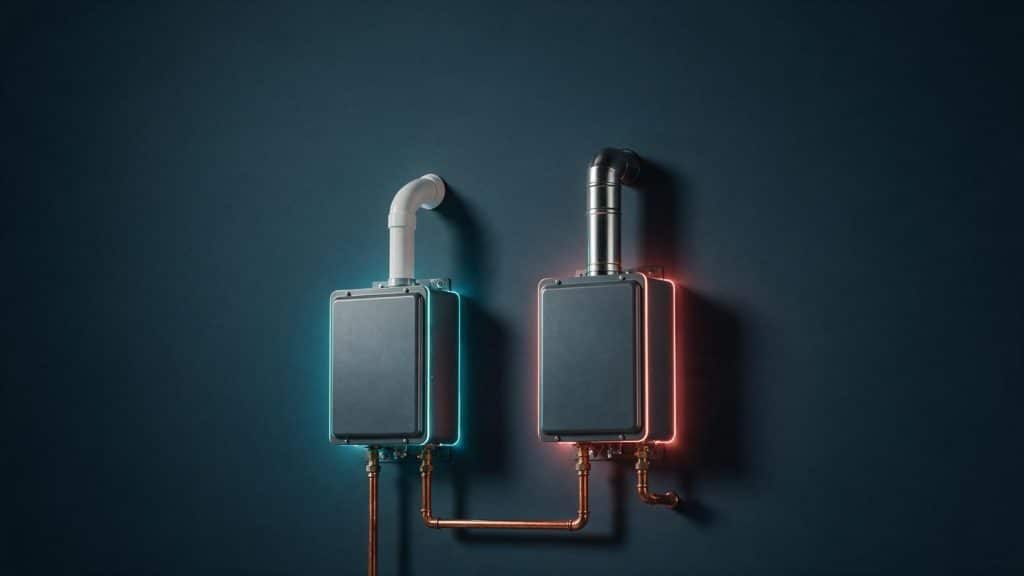
Two gas tankless units sit on the same shelf. Same brand, same headline flow rate, same warranty card. One of them costs four or five hundred dollars more, and the only thing that premium is really selling is a number printed on the EnergyGuide label: roughly 0.95 where the cheaper one says roughly 0.82. Thirteen points of efficiency, several hundred dollars. Somebody has to check whether those are equal.
The condensing vs non condensing tankless water heater question is a narrow one, and it only exists after the bigger argument is settled. That argument is whether a tankless unit belongs in your house at all, which I worked through in the ten-year comparison of tanks against tankless. It also assumes gas. There is no condensing version of an electric tankless, because there is no combustion and no flue, and that comparison turns out to be a question about your electrical service instead. Past both of those gates, you are looking at two machines that burn the same fuel and heat the same water. They differ in what they do with the exhaust, and that one design decision sets the efficiency, the price, the vent material and whether you need a drain. Venting is also what separates a direct vent from a power vent tank, if you end up staying with storage.
The short answer
- Two adults, ordinary use, short vent run: non-condensing. The fuel saving lands near $22 a year and the premium does not come back inside the life of the appliance.
- Family of four with stacked morning showers: condensing. At heavy draw the gap reaches roughly $53 a year, putting payback under ten years on a unit rated for fifteen to twenty.
- Long or awkward exhaust run through a finished house: condensing, almost regardless of the fuel math. Plastic vent pipe against stainless steel is where the money moves.
- Nowhere within reach to drain acidic condensate: non-condensing. A condensing unit makes liquid every time it fires and it has to go somewhere.
- Swapping a non-condensing unit with the stainless vent already in the wall: non-condensing. You paid for the expensive half years ago.
- Cabin, rental, or any low-occupancy house: non-condensing, without hesitation. Efficiency pays on volume, and there is no volume.
Condensing vs non-condensing tankless water heaters: what the second heat exchanger does
Burning natural gas makes two things you did not order: carbon dioxide and water vapour. The vapour carries latent heat, and in a conventional burner that heat leaves the building. A non-condensing tankless unit runs its exhaust out at something above 300 °F, hot enough that the vapour never turns back into liquid, and roughly a tenth of the fuel’s energy goes up the flue as steam you paid for.
A condensing unit puts a second heat exchanger downstream of the first and runs the incoming cold water through it before that water reaches the burner. The exhaust gets cooled below its dew point. The vapour condenses, gives up its latent heat into the cold supply, and the flue gas leaves at something closer to 100 to 140 °F. That is the whole trick. It is not a different burner, a different control board or a different grade of steel in the primary exchanger. It is one more coil and a colder chimney.
Two things follow from the colder chimney, and both matter more to your wallet than the efficiency number does. The exhaust is now cool enough for plastic pipe rather than stainless steel. And there is liquid water in the machine, mildly acidic from dissolved carbon dioxide, which needs a drain and often a neutralising cartridge on the way to it.
Side by side
| criteria | CONDENSINGtwo heat exchangers | NON-CONDENSINGone heat exchanger |
|---|---|---|
| Typical UEF | 0.90–0.96as listed for certified gas tanklessmore heat kept | 0.80–0.85latent heat leaves in the flue |
| Equipment price | $1,400–$2,000whole-house capacities | $1,000–$1,500same flow, simpler machinecheaper to buy |
| Gas burned per year | 143 therms136 therms delivered ÷ 0.9523 therms less | 166 therms136 therms delivered ÷ 0.82 |
| Annual fuel cost | $215at $1.50 a therm, 64 gal/daysaves $34 | $249at $1.50 a therm, 64 gal/day |
| Exhaust temperature | ~100–140 °Fbelow the flue-gas dew point | 300 °F+stays above the dew point by design |
| Vent material | PlasticPVC, CPVC or polypropylenefar cheaper per foot | Stainlesssealed Category III steel |
| Condensate | Yesacidic, needs a drain and often a neutraliser | Noneno drain to findsimpler siting |
| Rated lifespan | 15–20 yrsmore components in the gas path | 15–20 yrsfewer parts to fail |
Heavy household, or a long vent run? Condensing, and it is not close once the vent is priced. Two people, a short run through the nearest wall, no floor drain? Non-condensing. The efficiency you are buying has nothing to heat.

What thirteen points of efficiency is worth in dollars
Start from delivered heat, because that is the part that does not care which machine you bought. A household drawing 64 gallons a day at a 70 °F rise needs about 4,000 kWh of heat landing in the water every year. A therm is 29.3 kWh, so that is 136 therms of actual hot water. Now divide by efficiency to find out what the gas meter sees.
Non-condensing at UEF 0.82: 136 ÷ 0.82 = 166 therms burned, which is $249 a year at $1.50 a therm. Condensing at UEF 0.95: 136 ÷ 0.95 = 143 therms burned, or $215 a year. The gap is 23 therms and $34.
Thirty-four dollars. That is the number the shelf tag is asking five hundred dollars for, and at that rate the premium takes about fifteen years to come back. The appliance is rated for fifteen to twenty. So the average household is being offered a bet that pays out in the last third of the machine’s life, which is a thin margin to buy on.
The number moves fast with volume, though, and that is the real finding. Scale the same model to a light household at 40 gallons a day and delivered heat falls to about 85 therms: 104 therms burned against 89, a saving of $22 a year, payback around twenty-two years. Scale it to a heavy household at 100 gallons a day and delivered heat rises to about 213 therms: 259 therms burned against 224, a saving of $53 a year, payback under ten. Same two appliances, same price gap, and the answer flips depending on how many showers run before nine in the morning.
Gas price is the other lever, and it is a big one. The 23-therm gap is fixed by physics; the dollars attached to it are not. At $1.00 a therm the annual saving is $23. At $2.50, which is ordinary in New England and parts of the west coast, it is $58 and the payback drops to about nine years. Look up what your own utility charged last winter before you accept any national figure, mine included. And none of this arithmetic survives a badly sized unit, so settle capacity first: flow in gallons per minute times the temperature rise your groundwater actually forces, which is the worksheet in what size tankless water heater you need.
The vent decides this more often than the fuel bill does
Here is the part the efficiency comparison buries. A non-condensing unit throws exhaust hot enough that it has to travel inside sealed stainless steel. A condensing unit’s exhaust is cool enough for PVC, CPVC or polypropylene. Per foot, the stainless costs several times what the plastic costs, and the fittings follow the same ratio.
On a garage wall with the unit two feet from daylight, that difference is small money and the fuel math wins the argument. Run the same exhaust up through two floors of a finished house and the material gap can exceed the entire equipment premium, at which point the condensing unit is the cheaper buy before it has burned a single therm. I am not going to give you vent diameters or lengths. Those come from the specific model’s instructions and from a licensed installer looking at your actual walls. What I will say is that pricing the vent before pricing the appliance changes the answer often enough that skipping it is the most common mistake here.
The condensate cuts the other way. A condensing unit produces liquid every time it fires, that liquid is acidic, and it needs somewhere to go. A basement with a floor drain nearby makes this a non-event. A second-floor laundry closet makes it a design problem, and a design problem is how a cheap install becomes an expensive one.
Where I would not pay for condensing
I keep meeting people who bought the condensing unit for a two-person house with a short vent run and a bathroom nobody uses. On those numbers the premium comes back somewhere around year twenty-two, which is to say it does not come back before the appliance dies. That is not a saving. That is a wash with extra parts in the gas path.
Which raises the thing nobody can settle. A condensing unit has a secondary heat exchanger, a condensate trap and a drain line that a non-condensing unit does not, and plumber forums carry confident claims in both directions about what that does to service life. Some say the acidic condensate eats things. Some say the cooler running temperature is kinder to the machine. Neither camp can prove it, because there is no public model-level failure database for water heaters in the United States. Not for tanks, not for tankless, not for either side of this comparison. Anything you read that ranks reliability is one contractor’s territory, one warranty department’s private file, or an affiliate page. What both designs share is that they are repairable at the component level, which is why the twenty-year tankless lifespan comes with a condition rather than a guarantee.
And the concession that undercuts my own arithmetic: scale. Every figure above assumes both units keep their rated efficiency, and in hard water they will not. Mineral scale on a heat exchanger degrades output on both designs, and a condensing unit has two exchangers to lose. If your water is hard and descaling gets skipped, the expensive unit drifts toward the cheap unit’s performance and the payback you modelled never arrives. That is a maintenance question, not a purchase question, but it is the one that decides whether the purchase was right.
Sources
- US Department of Energy, Energy Saver: tankless water heaters and the Uniform Energy Factor test procedure.
- AHRI Directory of Certified Product Performance, residential gas instantaneous water heaters, for listed UEF and rated flow.
- ENERGY STAR certified product finder, tankless gas water heaters.
- FTC EnergyGuide label, which prints the estimated annual energy cost and the UEF behind it.
- Manufacturer specification sheets and installation manuals, for exhaust temperature, approved vent material and condensate handling.
- US Energy Information Administration, residential natural gas prices by state.
Decide it in this order. Work out your simultaneous flow and your temperature rise, get the vent run priced in both materials, then check whether your fuel gap is $22 a year or $53. Long vent, buy condensing and stop thinking about it. Short vent and a quiet house, take the $500 and put it toward a longer warranty. Every price, efficiency figure and running-cost model here is built the same way, and the workings are on the method page.