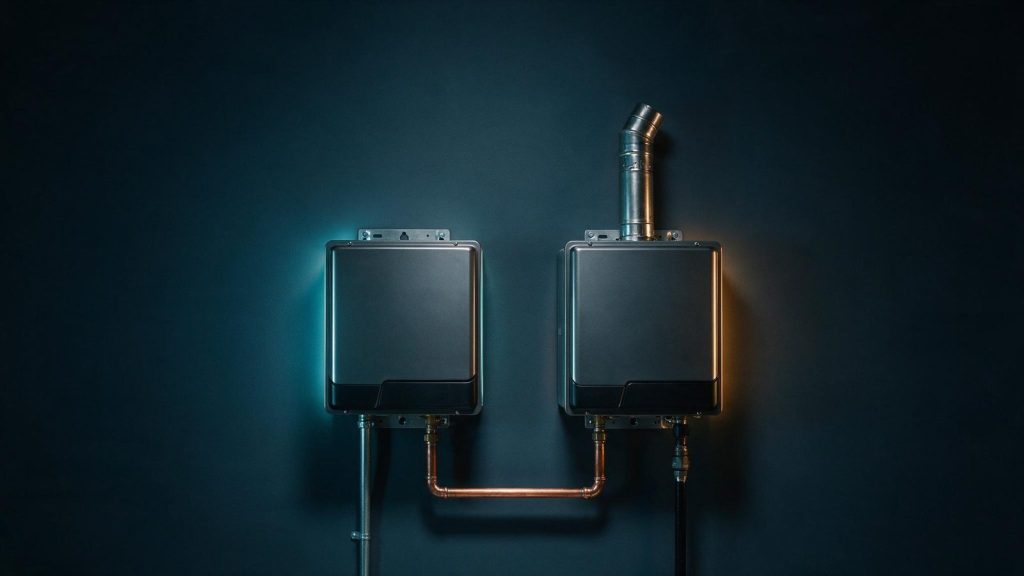
Both of these appliances heat water as it flows past and neither one keeps a reserve. That is where the resemblance ends. The choice between an electric vs gas tankless water heater is almost always settled by something already fixed in the fabric of the house, and it is not the fuel price on your bill. It is how much power the building can hand over at one moment. A whole-house electric unit is the largest instantaneous load most homes ever carry, and most existing American houses were never wired with one in mind.
So treat this as a service capacity question wearing a comparison-shopping costume. A gas burner rated at 199,000 BTU per hour is fed by an ordinary domestic gas line and nobody blinks. The electric equivalent of that same burner is about 58 kilowatts, and there is no quiet way to put 58 kilowatts into a house. If you have not yet decided between a storage tank and an on-demand unit at all, the ten-year tank versus tankless verdict is the argument to settle first. This page assumes you already want tankless and are picking the fuel.
The short answer
- Family of four with gas already at the meter: condensing gas tankless. It runs at roughly a third of the electric cost and it is the only one of the two that covers two simultaneous showers in a cold-water month.
- All-electric house in a cold climate: probably neither. A heat pump tank costs less to run than both of these and asks nothing unusual of the panel.
- All-electric house in the warm south, one or two people: whole-house electric tankless is genuinely workable here, because a 45 °F rise gets you about 55 percent more flow from the same kilowatts than a 70 °F rise does.
- One sink, shower or utility tap a long way from the heater: electric point-of-use, every time. This is the job electric tankless was designed for and the one it wins outright.
- Older house, service capacity unknown: ask a licensed electrician what the panel can carry before you shop anything. That answer decides your shortlist, not the spec sheet.
Electric vs gas tankless water heater: where the kilowatts go
Everything in this comparison falls out of one line of arithmetic. The heat an on-demand unit must add is flow multiplied by temperature rise, and in the units Americans buy in it comes out as kW = GPM × ΔT × 0.1465.
Put a 6 gallon-per-minute demand through it, which is two showers and a little slack, at the 70 °F rise a northern winter asks for. 6 × 70 × 0.1465 = 61.5 kW. Sixty-one kilowatts, continuously, for as long as anyone is standing under the water. That is a bigger draw than a range, an oven, a dryer and a central air conditioner all running at once. No residential electrical service in ordinary housing stock is built to absorb it.
Which is why whole-house electric tankless units are sold in the 18 to 36 kW band and stop there. Turn the equation around: 36 kW, the largest thing routinely offered for a house, divided by 70 × 0.1465, gives 3.5 gallons a minute. One decent shower, and nothing else running. The same box in south Florida, where incoming water sits near 70 °F and the rise you need is closer to 45, delivers 36 ÷ 6.59 = 5.5 GPM. Same appliance, different house, different answer. The tankless water heater size chart lays that flow out by fixture and climate band, so you can read your own row instead of doing the division.
A burner has no comparable ceiling. A 199,000 BTU per hour gas unit at UEF 0.95 puts roughly 189,000 BTU of heat into the water every hour, which works out to 5.4 GPM at a 70 °F rise and about 8.4 GPM at 45. The physics is identical. The supply side is not.
What your panel can carry is a question for a licensed electrician. I am not going to answer it on a web page and neither should anyone else. What matters is the order. That call comes before the shopping, because it can delete an entire fuel from your list in four minutes.
Side by side
| criteria | Electric, whole houseresistance, 18–36 kW | Gas, condensingburner, 150k–199k BTU/hr | Electric, point of useone fixture, 3–7 kW |
|---|---|---|---|
| Flow at a 70 °F rise | 1.8–3.5 GPMone shower, nothing else | 4.1–5.4 GPMtwo showers, slack at the top of the bandcovers a house | 0.3–0.7 GPMa hand basin, not a shower |
| Flow at a 45 °F rise | 2.7–5.5 GPMwarm-climate groundwater | 6.3–8.4 GPMheadroom to sparestill ahead | 0.5–1.1 GPMa low-flow shower at the top end |
| Typical UEF | 0.98–0.99no flue, nowhere for heat to escapehighest on paper | 0.90–0.96condensing; 0.80–0.85 if not | 0.98–0.99same reason |
| Ten-year energy, site model | $6,9404,082 kWh a year at $0.17 | $2,150143 therms a year at $1.503.2× cheaper | n/aserves one fixture, not the house |
| Equipment price | $500–$900the box itself is cheaplowest whole-house price | $1,000–$2,000condensing sits at the top | Lowestsmall single-fixture units sit well below the whole-house band |
| Exhaust | Nonenothing to ventno flue at all | Sealed flueplastic pipe on condensing, stainless on non-condensing | Nonefits in a vanity cabinet |
| What the house needs first | Electrical capacitythe constraint most older houses fail | Gas line and a flue routethe condition most gas-heated houses already meetusually already there | Modesta fraction of the whole-house electrical demand |
| Expected lifespan | 15–20 yrsscale on the elements is the clock | 15–20 yrsscale on the heat exchanger is the clock | 15–20 yrssimplest hardware in the category |
Gas already at the house? Condensing gas tankless, and the running-cost margin is not close. All-electric and cold? A heat pump tank beats both of these on money. One far-flung fixture? Point-of-use electric, and skip the argument entirely.
The ten-year bill, done out loud
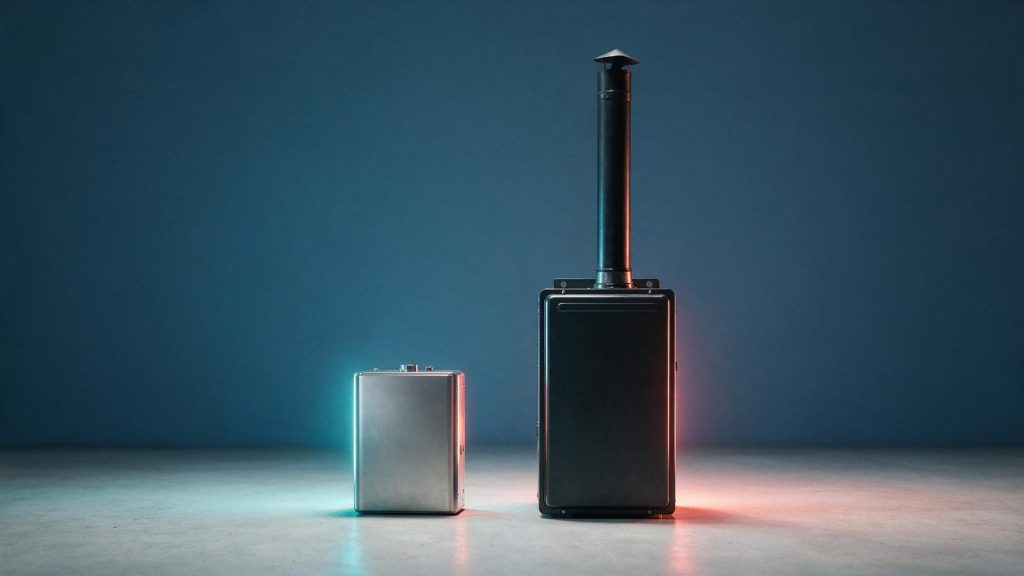
Efficiency is where electric looks unbeatable and it is a trap. An electric tankless is listed at UEF 0.98 to 0.99 because there is no flue for heat to leave through and no tank to sit around losing warmth. A condensing gas unit lands at 0.90 to 0.96. On the label, electric wins. On the bill it loses badly, because the two fuels are not priced anywhere near each other per unit of heat.
The site’s model household draws 64 gallons a day at a 70 °F rise, which is about 4,000 kWh of heat actually delivered into the water each year. Divide by efficiency to get what you buy.
Electric at UEF 0.98: 4,000 ÷ 0.98 = 4,082 kWh purchased. At $0.17 a kilowatt-hour that is $694 a year, or $6,940 across ten years. Condensing gas at UEF 0.95: those same 4,000 kWh of delivered heat are 136 therms, and 136 ÷ 0.95 = 143 therms purchased. At $1.50 a therm that is $215 a year, or $2,150 across ten years. The gap is $479 every year, $4,790 over the decade, and nothing in the equipment price comes close to erasing it.
Here is the number to carry to your own bill. A therm holds 29.3 kWh, so gas at $1.50 costs 5.1 cents per kilowatt-hour of raw energy, or 5.4 cents after dividing by 0.95. For electric tankless to match that, electricity would have to sell at roughly 5.3 cents a kilowatt-hour. EIA residential averages have not been near that for years, and in most states they are triple it. If your prices differ from the site constants, the same calculation applied to tanks is the gas versus electric price ratio.
One number ruins the tidiness of all this, and it deserves saying. A heat pump tank at UEF 3.5 needs 4,000 ÷ 3.5 = 1,143 kWh a year, which is $194 a year and $1,940 over ten. It beats the condensing gas tankless on running cost while using the fuel that just lost the argument. If your house is all-electric, the honest comparison is not the one on this page. It is heat pump against tankless, and it is not decided by efficiency alone.
The case electric tankless wins outright
All of the above is about heating a house. Point-of-use is a different appliance solving a different problem, and it is the reason electric tankless exists at all. A 3 to 7 kW unit under a sink serves one fixture, draws a fraction of what a whole-house model wants, needs no flue and fits in a vanity cabinet. At a 45 °F rise a 7 kW unit gives about 1.1 GPM. A hand basin and a slow shower, and nothing more. That is fine. It was never asked to do more.
The situations where this pays are easy to recognize. A guest bath at the far end of a ranch house where the tap runs cold for forty seconds. A garage sink. An addition the original plumbing never reached. The alternative is a long pipe run or a second tank, and the small electric unit wins on both cost and simplicity.
I keep meeting people who bought a whole-house electric tankless expecting point-of-use behavior at house scale. It is the most common disappointment in this category, and it is not the manufacturer’s fault. The box did what 27 kilowatts can do. Before you commit either way, run your actual simultaneous demand through the flow times rise sizing worksheet, because the sizing answer frequently makes the fuel decision for you.
What nobody can tell you
Which of these lasts longer in your house. Everyone asks it, and there is no public model-level failure database for water heaters in the United States, so any answer you read is somebody’s local sample or a number invented for a page like this one. I would not trust a durability ranking in this category from anyone, mine included. What is documented is that both technologies are scaled to death rather than worn out, that hardness accelerates it, and that the stated descaling interval is the real lifespan variable in both fuels.
Now the place my own recommendation is wrong. If you live where groundwater arrives at 65 °F or warmer, your household is one or two people, and the panel genuinely has room, a whole-house electric tankless at 27 to 36 kW is not a compromise. It is a clean answer with no flue, no combustion air, no condensate drain and a cheap box, and the running-cost gap on a small household’s usage is a good deal smaller than the $479 a year the model household pays. Run your own gallons, not mine.
The other soft spot is the gas column itself. I have quoted condensing figures throughout because that is what makes gas look as good as it does. A non-condensing unit sits at UEF 0.80 to 0.85 and costs several hundred dollars less, and whether the upgrade pays depends entirely on how much hot water the house uses. That arithmetic is worked through in condensing versus non-condensing, and for gas it is a real decision rather than a formality.
Sources
- DOE Energy Saver, demand-type water heater guidance, for the flow and temperature-rise method.
- AHRI Directory of Certified Product Performance, for rated input and certified UEF by model.
- ENERGY STAR certified water heater product finder, for the condensing gas efficiency band.
- FTC EnergyGuide labels, for annual energy use and the cost basis printed on the unit.
- Manufacturer specification sheets, for kW ratings, BTU per hour input, flow-versus-rise curves and descaling intervals.
- US Energy Information Administration, for residential electricity and gas prices against the site constants.
If you take one thing from this page, make it the order in which you ask the questions. What fuel is already at the house, then what the electrical service can carry, then what flow you need at your own groundwater temperature, and only then which brand and which model. The specs argument that dominates every forum thread is the last step, not the first. Our method page sets out where these figures come from and what we refuse to guess at.