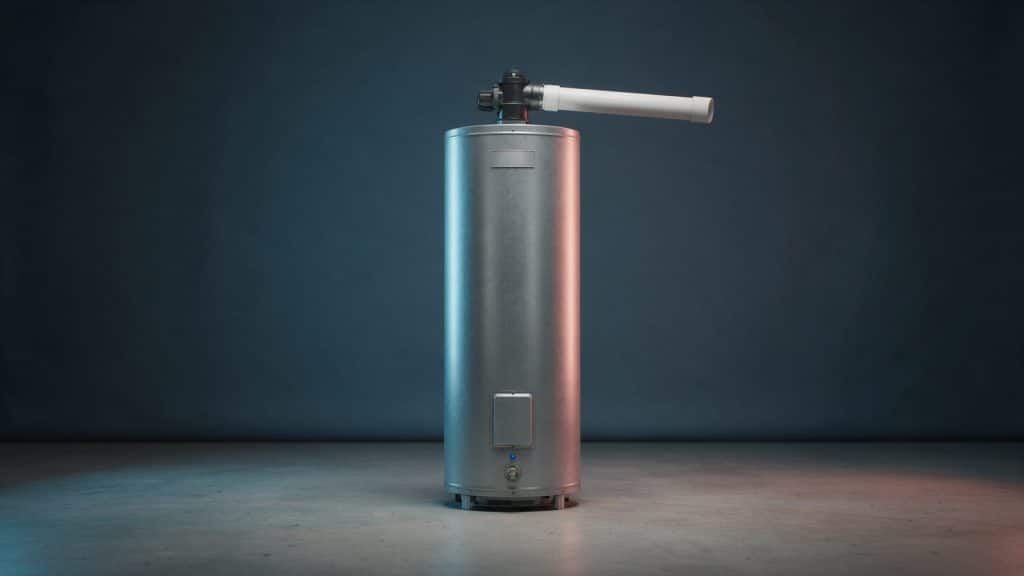
Direct vent vs power vent water heater is a question about where the combustion air comes from, not which appliance heats the water better. A direct vent unit pulls its combustion air from outside through a sealed coaxial pipe and never touches the air in the room it sits in. A power vent unit pulls that same air from wherever it stands, whether that is a utility closet, a garage, or an unfinished basement, and uses an electric blower to push the exhaust out through ordinary PVC pipe. Both are gas storage tanks under the jacket. The difference lives in the room, not in the tank.
Neither type is a separate water heater category the way tank and tankless are. Venting is a configuration bolted onto a conventional gas storage tank, which is why this comparison sits downstream of the bigger tank-versus-tankless decision. If that question is still open, start there. Everything below assumes the tank itself is already decided and the only thing left to pick is how it breathes.
The short answer
- Water heater going into a tight closet with the door usually shut: direct vent. A closed door cannot starve an appliance that gets its air from outside.
- Open basement or garage with real air volume and an outlet nearby: power vent works fine, and its PVC pipe run costs less material than the metal a standard atmospheric vent needs.
- No exterior wall within a short, straight shot of the tank: power vent’s blower gives an installer more routing flexibility than a passive coaxial system usually allows.
- A power outage matters to you, for whatever reason: direct vent runs on gas and natural draft alone. Power vent’s blower needs the outlet it is plugged into, so no power means no hot water either.
- A tight building envelope, big exhaust fans, or a wood stove already competing for indoor air: direct vent, because it is sealed from the room and cannot get pulled into that competition.
- Replacing a power vent unit that already has PVC pipe and a wall penetration in place: power vent again, unless the room itself has changed. Reusing an existing path is the cheapest version of either choice, and this site does not price what a plumber charges to install it.
How each one actually breathes
A direct vent water heater uses a coaxial vent: one pipe inside another, with separate chambers for intake and exhaust built into a single assembled piece. Outside air comes in through the outer chamber, exhaust leaves through the inner one, and the run typically goes straight out through a nearby exterior wall. A.O. Smith’s own venting documentation is explicit that this design needs no electrical power to operate, which is the appeal in a room where an outlet is inconvenient or where one more powered part is one more thing to fail.
A power vent water heater does the opposite. It draws combustion air from the room, and an electric blower mounted on top forces the exhaust out through PVC, ABS or CPVC pipe, run either vertically or horizontally. That fan is also what lets an installer put more distance and more bends between the tank and the outside wall than a coaxial system usually allows. The trade is the outlet. State Water Heaters’ own documentation is just as clear that a power vent unit needs one nearby, because the blower is not optional equipment. It is the vent.
Direct vent vs power vent water heater, side by side
| criteria | POWER VENTelectric blower | DIRECT VENTsealed coaxial |
|---|---|---|
| Combustion air source | Indoor room airpulled from wherever the tank stands | Outside air onlysealed coaxial intakesealed from the room |
| Electrical requirement | Needs an outletthe blower is the vent, not an accessory | Noneruns on gas and draft aloneworks in an outage |
| Typical vent material | PVC, ABS or CPVCcheaper than metal atmospheric pipecheaper material | Coaxial pipesized to the specific unit |
| Routing flexibility | Vertical or horizontalthe blower does the workmost flexible | Short, straight runtypically a nearby exterior wall only |
| Sound while running | Audible blower fanruns for several hours a day | No blowernothing but the burnerquietest |
| Best fit | Open utility room, garage, basementair to spare, outlet nearby | Sealed closet, tight envelopenegative-pressure roomsafer for tight spaces |
Room is tight, sealed, or already fighting for air? Direct vent removes the argument. Room is open with an outlet already there? Power vent’s PVC run is the cheaper material path, especially if one is already in the wall.
The arithmetic venting doesn’t touch
Venting configuration is not part of the combustion process. It decides where the intake air comes from and where the exhaust goes, not how much fuel the burner uses to deliver the same heat. This site models a household using 64 gallons a day at a 70 °F rise, which works out to 136.4 therms of heat actually delivered to the taps. Divide that by 0.65, a typical UEF for a non-condensing gas storage tank, and the burner draws 210 therms a year no matter which vent sits on top of it: $315 a year, $3,150 over ten years, at this site’s $1.50-a-therm constant. A tank with a power vent burns exactly the same gas as the same tank with a direct vent, because the burner and the UEF label do not know which pipe is attached to them. The number that actually moves between the two designs is not on any energy bill. It is what a plumber charges for the pipe, the wall penetration and the labor, and that is a local price this site will not invent.
Where the safety argument actually lives
Direct vent’s real advantage is not efficiency. It is isolation. A sealed coaxial system cannot backdraft into the room, because it was never drawing air from the room in the first place. That matters most in a tight modern envelope, where a kitchen exhaust fan, a clothes dryer and a fireplace can all be fighting the same appliance for makeup air at once. Power vent units are engineered and tested to move exhaust out reliably, and plenty of them run for years without incident in ordinary basements and garages. The isolation argument is about the room, not about a flaw in the appliance.
The exception I would flag is a house where a power vent unit is deliberately ducted to bring its combustion air in from outside, rather than pulling it from the room. That configuration exists, it closes most of the safety gap, and it is exactly why coaxial direct vent is not automatically required for every tight space. It is simply the more common, pre-packaged way manufacturers solve the same problem. A licensed installer is the one who can tell you whether your room needs that solution or whether it needs the coaxial system instead, because that is a code and clearance question. I would not guess at it from a comparison page, and neither should you.
What this site will not price
Two things are deliberately absent from everything above. The first is installation cost. What a plumber charges to run new vent pipe, cut a wall penetration or pull a permit is a local number that depends on your market and your specific room, and anyone quoting a national figure for that work is guessing. The second is reliability. No public database tracks failure rates for power vent versus direct vent units by brand or model, so a claim that one design breaks less than the other is not something I can back with a source. The manufacturer’s own warranty is the closest thing to real money on the line, and it is the only reliability signal worth reading.
Fuel usually settles before venting does. If gas versus electric is still an open question, the ratio that decides it answers that first. And if the appliance under discussion is actually a combination system rather than a simple storage tank, the boiler comparison covers configurations where venting gets more complicated still.
Sources
- A.O. Smith (hotwater.com), water heater venting guidance, for direct vent and power vent operating mechanics and electrical requirements.
- State Water Heaters, water heater venting guidance, for combustion air source and venting material differences.
- The modeling assumptions published on this site’s method page, for the constants behind the ten-year cost arithmetic.
Direct vent and power vent both do the same job on the same tank. They just disagree about where the air comes from and who supplies the electricity to move it out. Pick by the room, not by the price sticker on either box. If the tank’s capacity is still an open question, run the sizing worksheet before shopping rather than after. Every figure above comes from the same set of assumptions, and you can see them and change them on the method page.