
The pan under the tank is full, and the two boxes in front of you are a gas storage tank identical to the one that just died and a heat pump that costs roughly twice as much and hums while it works. Heat pump water heater vs gas is the one comparison on this site where I will not name a single winner, because the winner is decided by two numbers printed on your own utility bills. What I can give you is the line those two numbers have to cross.
That line is arithmetic, not opinion. Both appliances put identical heat into identical pipes. What differs is what each has to burn or draw to get it there, and converted into dollars per delivered therm the comparison collapses into one ratio you can work out from a bill in under a minute. If you are still choosing between appliance families rather than between fuels, the ten-year verdict on tanks against tankless is the better place to start. And if the heat pump is up against a gas tankless rather than a gas tank, read heat pump vs tankless next.
The short answer
- All-electric house, no gas line: this comparison is not live for you. The question is heat pump against a resistance tank, and there the gap is $545 a year, not $121.
- Gas at the meter, electricity below about 18 cents a kilowatt-hour per dollar a therm: the heat pump still wins on running cost, by roughly $121 a year at this site’s constants.
- Gas at the meter, electricity well above that ratio: the tank wins on running cost and on purchase price at once. Buy it and close the tab.
- Dead gas tank, live gas line, flue that still passes: the like-for-like swap is the cheapest route back to hot water there is, and the heat pump must beat that head start before efficiency gets a vote.
- Unheated garage or a cold basement in a cold state: derate the heat pump hard, and find out what that space does in February before committing.
- Humid basement in the southeast: the heat pump dries the room it stands in, a real second benefit that appears in no running-cost table, mine included.
Both boxes are buying the same thing
A water heater does not sell you gas or electricity. It sells you heat in the water, and how much your house needs has nothing to do with which appliance you pick. A household drawing 64 gallons a day at a 70 °F rise needs 13,637,568 BTU of heat into the water over a year. That is 136 therms. It is also 4,000 kilowatt-hours. Same heat, two units.
Input energy is delivered heat divided by efficiency, and that division is the entire model. A gas storage tank at a UEF of 0.65 has to burn 136 ÷ 0.65 = 210 therms, and 210 therms at $1.50 comes to $315 a year. A heat pump at a UEF of 3.5 draws 4,000 ÷ 3.5 = 1,143 kilowatt-hours, and 1,143 kilowatt-hours at $0.17 comes to $194 a year. Everything below is that division at different prices.
Side by side
| criteria | HEAT PUMPhybrid, 50–65 gal | GAS TANKatmospheric storage, 50 gal |
|---|---|---|
| Efficiency used here | UEF 3.5mid of the 3.0–4.0 bandmoves heat, does not make it | UEF 0.65mid of the 0.60–0.70 band |
| Input to deliver 136 therms of heat | 1,143 kWh4,000 ÷ 3.5 | 210 therms136 ÷ 0.65 |
| Cost per delivered therm | $1.428.4 kWh at $0.1738% cheaper per unit of heat | $2.311.54 therms at $1.50 |
| Running cost, per year | $194at $0.17/kWh$121 a year ahead | $315at $1.50/therm |
| Running cost, ten years | $1,940energy only$1,210 ahead | $3,150energy only |
| Equipment price | $1,500–$2,400appliance only, no labour | $700–$1,300appliance only, no labourcheapest box on the shelf |
| Expected service life | 10–15 yrscompressor and tanklonger, on paper | 8–12 yrsanode-limited |
| Recovery in a demand spike | Slowfast only when elements fire | Fastburner recovers a 50 gal tank quicklybest on back-to-back showers |
| Effect on the room it stands in | Cools, driesa gift in Houston, a tax in Duluth | Neutralbut needs a working flue |
Electricity under 18 cents a kWh for every dollar a therm? The heat pump wins the decade on running cost, but the $950 price premium eats most of that win. Above that ratio, or a dead tank on a live gas line? Gas, without much agonising.
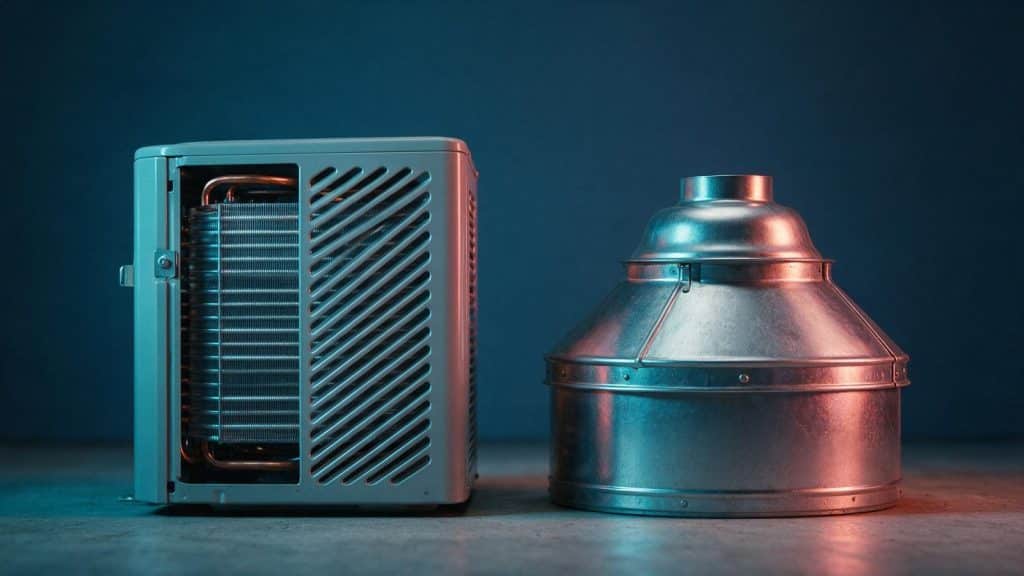
The crossover: heat pump water heater vs gas, in one ratio
Convert both to the same unit and the comparison stops being a matter of taste. One delivered therm is 100,000 BTU, or 29.3 kilowatt-hours of heat. A heat pump at 3.5 draws 29.3 ÷ 3.5 = 8.4 kWh to put that therm in the water, which costs $1.42 at $0.17. A gas tank at 0.65 burns 1 ÷ 0.65 = 1.54 therms to deliver the same therm, which costs $2.31 at $1.50. Gas is 63 percent dearer per unit of heat, at these prices.
Now solve for the prices at which they tie. Set 8.4 × (electricity price) equal to 1.54 × (gas price) and the answer arrives as a ratio, not a pair of numbers: the heat pump stays ahead while your electricity price in cents per kilowatt-hour is below roughly 18.4 times your gas price in dollars per therm. The pocket version. Take your electricity rate in cents, divide by your gas rate in dollars, read the answer. Under 18, heat pump. Over 18, gas tank. At this site’s constants, 17 ÷ 1.50 = 11.3, comfortably on the heat pump’s side.
That 18.4 belongs to one specific pairing, so treat it as the centre of a band rather than a fence post. A mediocre heat pump at 3.0 against a good gas tank at 0.70 moves the crossover down to 14.6. A strong heat pump at 4.0 against a tired tank at 0.60 pushes it up to 22.8. The honest statement is that the line lives between about 15 and 23, and if your ratio lands inside it the running costs are a wash, so noise, space and recovery speed decide instead. The same logic sits underneath the broader gas against electric comparison, where the spread is wider still.
The head start gas already has
Here is the concession this article owes you, because the table above makes the heat pump look more decisive than it is. Equipment for a 50-gallon gas tank runs $700 to $1,300. A 50 to 65 gallon hybrid runs $1,500 to $2,400. Take the middles and the heat pump asks for about $950 more up front. Divide $950 by the $121 a year it saves and the payback lands close to eight years, on an appliance rated for ten to fifteen. Take the extremes and the answer swings hard: a cheap hybrid against a premium gas tank clears in under two years, a top hybrid against a builder-grade tank in fourteen, longer than either box is promised to survive.
Contrast that with the same heat pump against an electric resistance tank, where the gap is $545 a year and the premium clears in a bit over two. Against resistance the heat pump is not a close call, and I will argue that with anyone. Against gas it is a genuine argument, and anyone telling you it is obvious has not done the division.
Two more things belong on gas’s side of the ledger. This site does not quote installation, because labour is local and any figure I printed would be wrong for most readers. It is fair to say which way it pushes, though. Dropping a new gas tank onto a live line and a flue that still passes is the simplest job in the category. Standing a heat pump there instead is a fuel switch, and a fuel switch needs electrical capacity that may not be waiting for it. That asymmetry favours gas. Second, the federal 25C credit that once took 30 percent off a heat pump water heater expired on 31 December 2025, so do not build it into your arithmetic. Utility and state incentives, where offered, remain, and they are worth twenty minutes of searching: $400 off drags that eight-year payback back to about four and a half.
The failure mode that erases the whole advantage
Every heat pump water heater sold for a house is a hybrid, carrying resistance elements as backup. Those elements are why it never leaves you cold, and they are also where the savings quietly go to die. When the compressor cannot keep up, or the air around it gets too cold to work in, the unit falls back on the elements and becomes an ordinary electric tank. At a UEF of 0.92 that same household draws 4,348 kilowatt-hours, or $739 a year. Read that against the gas tank’s $315. It is not slightly worse. It is more than twice as bad, which turns the appliance you bought to save money into the most expensive way to heat water in the house.
I keep meeting people who priced a heat pump against last winter’s gas bill and never checked what the room it will stand in does in February. That check decides the purchase more often than the ratio does. A heat pump wants air volume and wants that air reasonably warm. A sealed, unheated garage in Minnesota gives it neither, and the unit spends the coldest months on its elements. It also makes compressor noise and produces condensate that has to go somewhere. None of that is a deal-breaker in a large southern basement. All of it can be one in a small cold utility room. The operating modes are worth understanding before you buy.
One more thing nobody can tell you, including me. Neither price in that ratio holds still for ten years. Residential gas has moved sharply in both directions over recent winters, electricity has drifted up more steadily, and nobody publishing a ten-year model knows which line goes where next. The ratio is a snapshot of today’s bill. The further your own number sits from that 15-to-23 band, the less the future matters. Whichever box you land on, size it before you buy it, because every figure above assumes the appliance keeps up with the house. Our sizing worksheet is the next step.
Sources
- DOE Energy Saver, the heat pump and conventional storage water heater pages, for operating principle and efficiency bands.
- AHRI Directory of Certified Product Performance, for the certified UEF and first-hour rating of any model you shortlist.
- ENERGY STAR certified water heater product finder, for which hybrids qualify and which utility programs list them.
- FTC EnergyGuide label, for the estimated annual energy cost on the box and the national rates behind it.
- US EIA residential natural gas and electricity price series, for your state’s rates rather than this site’s constants.
- Manufacturer specification sheets and warranty documents, for ambient temperature limits, sound ratings and condensate requirements.
Work out your own ratio before you shop. It is the only part of this comparison that is genuinely yours. Divide your electricity rate in cents by your gas rate in dollars. Under 15 and the heat pump wins the decade even on a pessimistic pairing. Over 23 and gas wins even on an optimistic one. In between, the money is a tie and the room, the noise and the second shower decide it. Every figure here comes from the same published inputs and the same division, laid out on our method page.
1 comment