
Search for the best water heater brands and you get a numbered list. The names on that list are all fine. The problem is what the numbering quietly implies, which is that somebody counted failures across a few hundred thousand installed tanks and sorted the results. Nobody did. No public, model-level failure database exists for water heaters sold in the United States, which means every ranking you will read is either one plumber’s sample of one city’s water or a page that earns money per click.
So this page refuses the premise and hands you the two things that can actually be checked. First, who owns which badge, because nine of the badges in this category belong to two companies. Second, which line is strongest for one specific need. The variable that decides how long your tank survives is the chemistry of the water going into it, not the logo on the jacket, and that is a fact about your zip code rather than about Rheem.
The short answer
- All-electric house, replacing a resistance tank: buy a heat pump line. Rheem ProTerra, A.O. Smith’s hybrid Signature units, Bradford White AeroTherm. Which badge you pick is worth a few hundred dollars. Which line you pick is worth several thousand.
- Gas at the meter, tank died this morning: Rheem at one big-box chain, A.O. Smith at the other. Compare the warranty tier and the shelf price that day, then stop.
- You are hiring a plumber anyway: Bradford White is a sound default. It is wholesale-only, so your contractor buys it and there is no Saturday afternoon option by design.
- Whole-house gas tankless: the specialists. Rinnai and Navien build deeper tankless lines than the tank makers do, and the parts bench behind them is deeper too.
- Well water, high hardness, tired of anode rods: Rheem’s Marathon uses a non-metallic tank with no anode at all, sold through electric cooperatives rather than stores.
- You wanted one best brand: there is not one, and anybody who names one is either selling it or generalizing from their own van.
Why the best water heater brands cannot be ranked
Cars have a recall database and an army of insurance actuaries counting outcomes. Appliances have neither. No federal agency publishes water heater failure rates by model, manufacturers keep warranty claim data to themselves, and the certification bodies certify performance rather than durability. The AHRI directory will tell you a given model’s first-hour rating and its UEF, both verified under test. It will not tell you what share of them started weeping at the weld in year seven.
What fills that gap is anecdote delivered in a confident voice. A plumber who pulls forty dead tanks a year in Phoenix does have a real dataset. It is a real dataset about Phoenix water, at Phoenix inlet temperatures, on the two brands his wholesaler stocks. Move the same man to Portland and his rankings would rearrange themselves inside three years. I keep meeting people who read a forum thread stitched together from forty of these local samples, treat it as a controlled study, and then buy on brand while ignoring the capacity question that will irritate them every single morning.
The closest thing to published reliability data is the warranty ladder, and almost nobody reads it that way. When a manufacturer sells what is essentially the same tank in a six-year version and a twelve-year version, and the twelve-year version carries a heavier or second anode and costs another hundred and fifty dollars, that price gap is the company’s own bet on how long its steel lasts. It is priced by the only people who hold the claims data. A star rating on a retail site is not.
Side by side, by how you buy it
Three entities cover most of the residential market. Two of them are conglomerates wearing several faces, and the third refuses to sell to you directly. That structure, not engineering, is what separates them on the day you buy.
| criteria | RHEEM GROUPRheem, Ruud, Richmond, Eemax | A.O. SMITH GROUPA.O. Smith, State, American, Reliance, Lochinvar | BRADFORD WHITEindependent, trade only |
|---|---|---|---|
| Water heater badges owned | 4Eemax is the electric tankless arm | 5Lochinvar sits on the commercial side | 1Laars and Niles are its boiler and tank arms |
| How you buy it | Retail, trade, co-opwidest distribution in the categorymost routes | Retail and tradedifferent badge per channel | Wholesale onlya contractor buys it for yousingle channel |
| Dead tank replaced today | Yesaisle stock in common sizes | Yesaisle stock in common sizeson the shelf | Noonly as fast as your plumber |
| Retail warranty ladder | 6 / 9 / 12 yrtiers priced separately | 6 / 9 / 10-12 yrtiers priced separately | Set by lineno retail tier shopping |
| Heat pump line | ProTerrawidely stocked | Hybrid Signatureretail and trade versions | AeroThermtrade channel only |
| Tankless presence | Gas and electricEemax covers point-of-use | Gas linenarrower than the specialists | Infinitia side line, not the core |
| Public failure data | Noneno database exists | Noneno database exists | Noneno database exists |
Standing in a store with a cold shower waiting? Rheem or A.O. Smith, and buy the warranty tier rather than the badge. Calling a plumber regardless? Bradford White is a defensible default, because you are paying for one consistent product instead of a retail ladder. Buying tankless? Leave all three and look at the specialists.
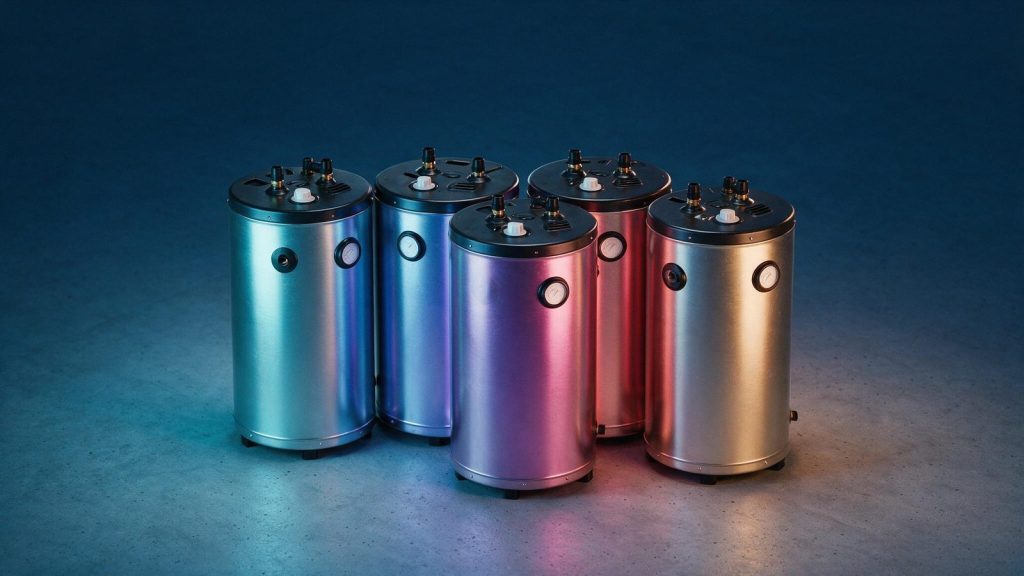
The line you choose beats the badge you choose
Hold the household constant and change only the appliance. A house drawing 64 gallons a day at a 70 degree rise needs roughly 4,000 kWh of delivered heat a year. Divide that by the efficiency of the machine to find what you actually pay for.
A resistance electric tank runs a UEF near 0.92. So 4,000 divided by 0.92 is 4,348 kWh drawn from the meter, and at $0.17 that is $739 a year. Ten years: $7,390. A heat pump on identical duty runs a UEF near 3.5. So 4,000 divided by 3.5 is 1,143 kWh, or $194 a year. Ten years: $1,940. The difference is $5,450, and both appliances are available with the same three badges on the front.
The heat pump costs $1,500 to $2,400 as equipment against $550 to $900 for the resistance tank, so worst case you start about $1,850 behind and cross over somewhere in year four. If gas is already at the house the arithmetic lands differently: 4,000 kWh of delivered heat is about 136 therms, and at a storage-tank UEF of 0.62 that is 219 therms bought, or $329 a year and $3,290 over the decade. Cheaper to run than resistance, dearer than a heat pump.
Now set that against the brand decision. Two 50-gallon gas tanks of the same tier from the two big owners will sit within about a hundred dollars of each other and within a point or two of UEF, which is why the Rheem against A.O. Smith comparison keeps landing on a tie. Thousands of dollars hang on the line. Tens of dollars hang on the logo. The internet has this backwards. Picking the tank type first narrows that field: see the best heat pump water heater by household for the room and panel checks first.
Strongest line for a given need
Rheem’s advantage is reach. Between its own badge, Ruud on the trade counter, Richmond in independent stores and Eemax in point-of-use electric, it has a product in nearly every channel a homeowner might walk into, which matters enormously at eight in the evening with no hot water. The badges are largely the same tanks with different jackets and different warranty administrators, and the badge map is worth reading once if only to learn that Reliance belongs to A.O. Smith rather than Rheem, which is the single most repeated error in this category.
A.O. Smith’s advantage is that it runs a genuine two-channel business. The retail Signature ladder and the State and American trade lines are engineered from the same catalog, so a contractor can get you a heavier-duty unit than the store stocks without leaving the family. Lochinvar sits above that for commercial work. If you want something more serious than the aisle version, this group has one and will sell it to a plumber.
Bradford White’s advantage is the thing that also makes it inconvenient. It sells only through wholesale, so there is no consumer-grade tier engineered down to a retail price point, and the argument for it rests on documented design choices such as its glass lining and the cold-water inlet arrangement rather than on any published durability record. That store brand against trade brand question is a real one, and it is decided by whether you were hiring somebody anyway.
For tankless, the honest recommendation leaves all three. Rinnai and Navien build tankless as the main event rather than as a line extension, which shows up in recirculation options, in the depth of the parts bench and in how many local techs have actually opened one. The specialist against full-line question is the one to settle if that is your direction. For the unit itself, the best tankless water heater by household works through fuel, flow and water hardness without ranking any model.
What I would check on the day, and where I am wrong
Three checks, in order. Read the yellow EnergyGuide label and the model number, then confirm that exact model in the AHRI directory or the ENERGY STAR product finder, because family names like Performance or Signature cover several very different units. Check the first-hour rating against your own peak hour rather than the gallon number on the front, which decides whether the second shower works. And read the warranty tier as a price signal, not a promise. I would not pay for a retail extended service plan on a seven-hundred-dollar appliance. I would pay the tier premium, because that money buys metal inside the tank.
Here is where my own advice breaks down. If your water is genuinely aggressive and you have a plumber who has been pulling tanks out of your neighborhood for twenty years, his brand preference is better information than anything on this page. It is a local sample of a local failure mode, which is exactly the right shape of evidence here. I would take it without arguing. What I would not take is that same preference repeated by a stranger three states away, or arranged into a top ten with affiliate buttons under it.
The other thing I cannot tell you is which brand will still be honoring its warranty in year eleven with the same paperwork, because ownership and administration in this industry move. That is unknowable at purchase, and pretending otherwise would be the same failure as ranking them. Get the capacity right first, using the sizing worksheet, and the badge shrinks to what it is. A 50-gallon gas tank adds one more fork before the badge even matters: how an atmospheric model compares with a power vent at that size.
Sources
- AHRI Directory of Certified Product Performance, for verified first-hour rating and UEF by model number.
- ENERGY STAR certified water heater product finder, for the current qualifying heat pump and condensing models.
- FTC EnergyGuide label, for the estimated annual energy figure printed on the unit itself.
- US Department of Energy, Energy Saver, for water heater types, efficiency definitions and lifespan ranges.
- Manufacturer residential warranty documents and specification sheets from Rheem, A.O. Smith, Bradford White and Rinnai, for tier structure and line composition.
- US Energy Information Administration, for residential electricity and natural gas prices.
If you came here for a winner, the useful version is this: pick the fuel, pick the line, then buy whichever badge in front of you carries the better warranty tier for the money that day. Everything else is noise dressed up as research. The arithmetic, its assumptions and the reason this site will not publish a ranking are set out on the method page.