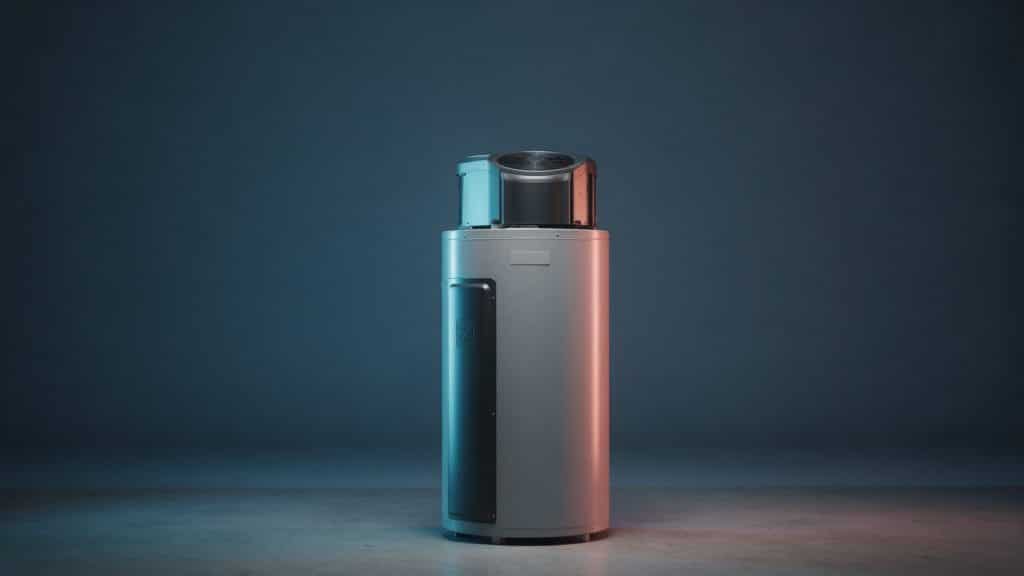
The best heat pump water heater is not a model name. It is the one your closet can vent and your panel can feed, because a heat pump tank that cannot breathe or draw power quietly turns itself back into an expensive resistance heater. That single constraint eliminates most “top ten” lists before the first efficiency number even shows up, the same gap I laid out for tankless models in the piece on water heater brands: no public reliability database exists to crown a winner, so the honest ranking is by household, not by badge.
What can be ranked is fit. Three facts about your house decide before a brand enters the conversation: how much air space and warmth the installation spot actually has, what your electrical panel can spare, and whether the running-cost gap is wide enough in your case to matter. This page walks them in that order and prints the arithmetic behind the headline number, the $545-a-year gap against a plain resistance tank. If a tank of any kind is still an open question for you, the tank versus tankless comparison is the fair place to settle that first.
The short answer
- All-electric house with a furnace room, laundry closet or unconditioned basement that never drops below 40 °F: a heat pump tank is close to a free upgrade. It runs about $194 a year against $739 for a straight resistance tank.
- A tight utility closet with barely enough room to open the access panel: check the air volume before you buy. ENERGY STAR asks for roughly 1,000 cubic feet around the unit, and a closet door alone rarely supplies that.
- Gas already at the meter and the current tank works fine: a heat pump tank usually still wins on running cost, but a gas unit closes most of the gap. Heat pump against gas, with the crossover worked out, has the full comparison before you rip out a working gas line.
- A finished, lived-in room kept at 65 to 70 °F year-round with no spare heat to steal: read the cooling-and-dehumidifying note below before you put a heat pump in a room someone sits in all winter.
- A panel already near its limit, or two people replacing a dead tank on a tight budget: a resistance tank costs less than half to buy, and the smaller the household, the longer the heat pump’s savings take to catch up.
How to pick the best heat pump water heater: room, panel, then the math
A heat pump water heater does not create heat the way an element or a burner does. A compressor pulls warmth out of the air around the tank and pumps it into the water through a refrigerant loop, the same cycle that runs a window air conditioner in reverse. That is why the room around the unit matters as much as the tank itself: pull heat out of a small, sealed closet long enough and the compressor runs out of warm air to work with. ENERGY STAR’s own buying guidance is specific about this, calling for an installation space that stays between 40 °F and 90 °F year-round and offers about 1,000 cubic feet of air around the unit, ideally a room that already runs a little warm, like one next to a furnace.
Most hybrid tanks carry backup resistance elements for exactly this reason. When the room runs cold, when recovery demand spikes past what the compressor can supply, or when the unit is switched to a straight electric mode, the elements take over and the running cost for that stretch looks like a plain resistance tank’s, not a heat pump’s. A unit installed in an unheated garage in a cold climate can spend a surprising share of the year in that backup mode, which is the single biggest reason a heat pump tank underperforms its rating in the field. One side effect worth knowing before you buy: the same compressor that heats your water also cools and dries the room it sits in, useful in a humid basement, unwelcome in a finished room someone actually uses.
Side by side
| criteria | HEAT PUMPhybrid, UEF 3.5 | ELECTRIC RESISTANCEstandard tank, UEF 0.92 | GAS STORAGEstandard tank, UEF 0.65 |
|---|---|---|---|
| Energy used per year | 1,143 kWh4,000 kWh delivered ÷ 3.5lowest draw | 4,348 kWh4,000 kWh delivered ÷ 0.92 | 210 therms136.4 therms delivered ÷ 0.65 |
| Running cost per year | $1941,143 kWh at $0.17cheapest to run | $7394,348 kWh at $0.17 | $315210 therms at $1.50 |
| Ten-year energy | $1,940site model | $7,390site model | $3,150site model |
| Equipment price | $1,500 to $2,40050 to 65 gallon units | $550 to $90050 gallon tankcheapest to buy | $700 to $1,30050 gallon tank |
| What the space needs first | 1,000 ft³ of air40 to 90 °F ambient, per ENERGY STAR | Panel capacitya dedicated circuit, sized by an electrician | Gas line and ventcombustion air and a flue route |
| Expected lifespan | 10 to 15 yrsthe compressor is the wear part | 8 to 12 yrselements and tank corrosion | 8 to 12 yrstank corrosion sets the clock |
Room and power both available? Heat pump, and the running-cost gap pays for the higher price tag inside the decade. Space is tight or cold? A resistance tank costs less and asks nothing of the room. Gas already runs to the spot? Run the gas storage numbers before assuming electric wins by default.
The $545 gap, done out loud
The site’s model household draws 64 gallons a day at a 70 °F rise, which works out to about 4,000 kWh of heat that has to land in the water every year, whatever the appliance. Divide that delivered-heat number by the appliance’s efficiency to see what the meter actually records. A heat pump tank at UEF 3.5: 4,000 ÷ 3.5 is about 1,143 kWh, and at $0.17 a kilowatt-hour that is $194 a year. A plain resistance tank at UEF 0.92: 4,000 ÷ 0.92 is about 4,348 kWh, or $739 a year. The difference, $545 a year, is $5,450 over a ten-year appliance life, and no realistic gap in purchase price closes it. The full heat pump versus electric breakdown walks through where a small household can still land on the resistance side of that math.
Gas storage sits in between on running cost but arrives at its number a different way. The same household needs about 136.4 therms of delivered heat a year (the same 4,000 kWh, converted to gas units before the efficiency division). A standard gas tank at UEF 0.65: 136.4 ÷ 0.65 is about 210 therms, and at $1.50 a therm that is $315 a year, cheaper to run than resistance electric but well behind the heat pump. If your own electricity or gas rate is far from those figures, redo both divisions with your numbers before trusting mine; the ranking can move if your utility prices do.
What ENERGY STAR’s own list shows, and what it does not
ENERGY STAR keeps a live database of every certified heat pump water heater, sorted by Uniform Energy Factor. As of this writing it lists 514 certified models, and the top of that list, a pair of 50- and 80-gallon units, posts a UEF of 4.5, well above the 3.5 this site uses as its modeling baseline. That gap matters: a genuinely top-rated model can beat the $194-a-year figure above, while a bottom-of-the-list certified unit can land closer to resistance electric than the headline “up to 5x efficiency” marketing suggests. The finder is public and free to search by capacity and by UEF; I would use it to shortlist two or three models before calling an installer, not to pick a winner from a review page.
ENERGY STAR’s buying guidance also flags a detail most retail listings skip: refrigerant. Some certified heat pump water heaters use R-744, carbon dioxide, as the refrigerant, which carries a global warming potential close to zero next to older refrigerants rated in the thousands. It is not a running-cost question, so it will not move the numbers in the table above, but it is a real difference between two otherwise similar units, and it is the kind of detail a rushed replacement skips.
Where I would not put one, and what nobody can tell you
I would not install a heat pump water heater in a small conditioned room that a family actually lives in or works in through the winter, a finished basement office, a converted closet off a bedroom. The same cooling effect that is a bonus in a sticky utility room becomes a fight with the furnace in a room someone is trying to keep warm, and that fight shows up on the heating bill even though it never appears in a water-heating comparison. I also would not buy one for a rental or a low-use household of one or two people; the savings scale with gallons used, and a light household leaves little for the compressor’s higher price tag to earn back before the next move. A resistance tank and a whole-house electric tankless are compared head to head in the best electric water heater guide.
Now the concession, because the verdict above is not free of one. A compressor is a mechanical part that a resistance element simply is not, and nobody, on this site or anywhere else, can hand you a model-by-model failure rate, because no public database of water heater failures exists by brand or by model. The 10 to 15 year lifespan in the table is a reasonable range, not a guarantee for your unit, the same honesty I owe the tank-life numbers in how long water heaters actually last, and the maintenance that keeps a heat pump tank near its rated efficiency, mainly a clean air filter, is real work that a plain resistance tank never asks for. If that upkeep will not happen in your house, the running-cost gap on paper will not survive contact with the appliance in your closet.
Sources
- ENERGY STAR, “Heat Pump Water Heaters” buying guidance page: installation space and ambient-temperature requirements, refrigerant global warming potential note.
- ENERGY STAR Product Finder, Certified Heat Pump Water Heaters results, sorted by Uniform Energy Factor: 514 listed models and the current top UEF score.
- The modeling assumptions published on the method page: delivered-heat anchor, prices, UEF bands and equipment ranges.
Check the room before you check a model number: air space, ambient temperature and what the panel can spare decide more of this purchase than any spec sheet does. Every price, efficiency figure and running-cost model on this page is built the same way, and the workings are on the method page.