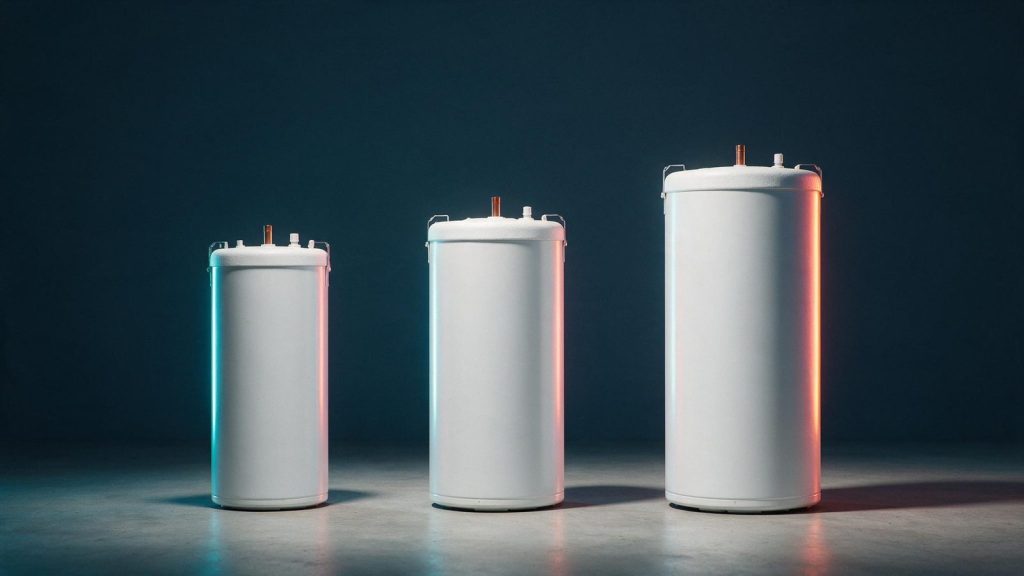
Almost everyone sizes a water heater the same way: they look at the label on the one that just died and buy the same number. That works right up until the day it doesn’t, which is usually the day a teenager moves in or the second bathroom gets finished.
Gallons is the wrong number to shop on. The number that decides whether the fourth shower runs cold is the first-hour rating, and it is printed on the yellow EnergyGuide label of every unit sold in the US. Start with the tool below for a rough answer, then do the worksheet underneath it if you want the real one.
Start with how many people live in the house
Undersize it and the fourth shower runs cold. Oversize it and you pay to keep water hot for nobody. This is the starting point, not the answer.
How many people are in your home?
Quick estimate only. Bathrooms, climate and fuel type all move these numbers, sometimes by a full tank size. The worksheet below is the honest version.
The number on the label is not the number that matters
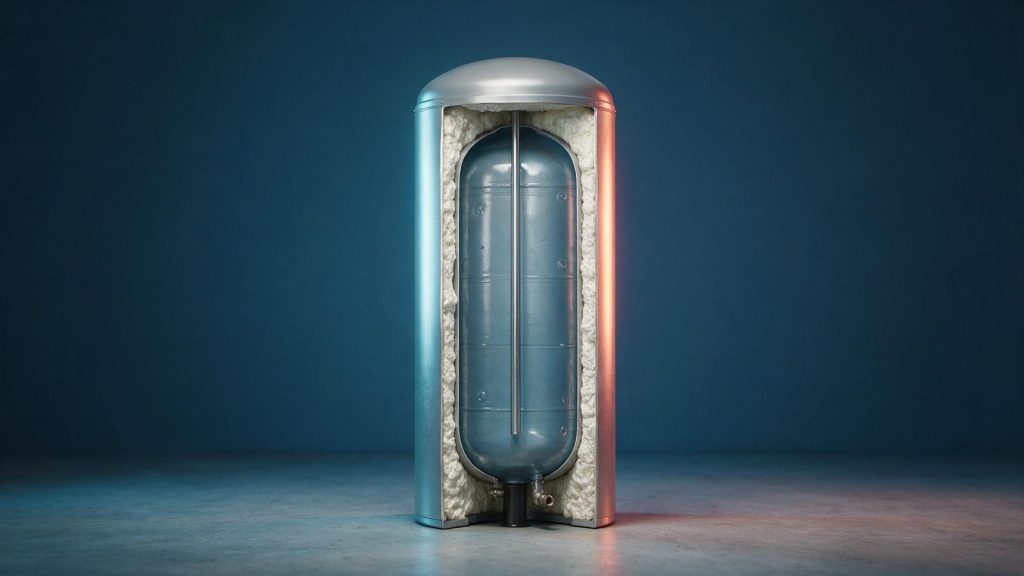
A 50 gallon tank does not give you 50 gallons of shower. It gives you roughly 35 usable gallons of stored hot water, because the cold water arriving at the bottom mixes with what is left as you draw it down, and because you are mixing 120 degree water with cold at the valve anyway.
The first-hour rating adds the reheat to the storage. It is what the unit can actually deliver in sixty minutes starting from full and hot: usable storage plus one hour of recovery. That is the number to match against your peak hour.
You can sanity check any FHR on a label with two lines of arithmetic. A 4,500 watt element puts out 15,350 BTU per hour, which at a 70 degree rise is about 26 gallons an hour. Add that to 35 usable gallons and you get 61, which is why a 50 gallon electric tank is labeled around 62. A 40,000 BTU gas burner at 75 percent efficiency recovers about 51 gallons an hour, so a 40 gallon gas tank is labeled near 78 despite holding ten gallons less. Same closet, same price bracket, wildly different appliance.
The peak hour worksheet
Forget the daily total. Nobody runs out of hot water over the course of a day. They run out between 6:45 and 7:45 in the morning. Write down what actually happens in your busiest hour and add up the hot water.
| Use | Planning figure (gal) | Low-flow reality (gal) |
|---|---|---|
| Shower | 20 | 14 at 1.8 GPM for 8 minutes |
| Bath | 20 | 20, this one does not shrink |
| Shaving, hand and face washing | 2–4 | 2 |
| Hand dishwashing or food prep | 4 | 4 |
| Automatic dishwasher | 6 | 4 on a modern machine |
| Clothes washer, warm cycle | 7 | 3–7, high-efficiency machines use far less |
A worked example. Two adults and two teenagers, weekday morning: three showers at 20 gallons, one shave at 2, one round of hand washing at 4. That is 66 gallons in the peak hour. Buy a unit with a first-hour rating of 66 or better, and only then start looking at tank capacity, which for that FHR will be a 50 gallon electric or a 40 gallon gas.
Use the conservative column if the showers in your house are long or the fixtures are old. Use the right-hand column if you have replaced the shower heads recently. The difference between the two columns on a four-person morning is 18 gallons, which is a whole tank size.
Sizes by household, and what changes them
| People | Electric tank | Gas tank | First-hour rating | Tankless flow |
|---|---|---|---|---|
| 1–2 | 30–40 gal | 30–40 gal | 45+ | 5–6 GPM |
| 3–4 | 50 gal | 40–50 gal | 60+ | 7–8 GPM |
| 5–6 | 66–80 gal | 50–66 gal | 72+ | 8–9 GPM |
| 7+ | 80 gal or two units | 75–80 gal | 84+ | 10–11 GPM, realistically two units |
Three things push a household up a row: a soaking tub, two showers that genuinely run at the same time, and a laundry habit that lands inside the morning peak. One thing pushes it down: nobody being home between 8 and 6, which makes a smaller tank with a strong recovery rate the better buy.
Bathroom count is the worst proxy of the three, and it is the one most retail staff use. A four-bathroom house with two occupants has the hot water demand of a two-bathroom house with two occupants. Fixtures do not shower themselves.
Sizing a tankless unit is a different question entirely
There is no storage, so gallons never enter into it. You size on two numbers multiplied together: how many gallons per minute you want to run at once, and how many degrees you need to raise them.
The second number is geography. Ground water arrives at about 40 degrees in Minnesota in February and about 72 in central Florida. To reach a 120 degree tap that is a 80 degree rise in one place and a 48 degree rise in the other, and a tankless unit’s output collapses as the rise climbs.
| Region | Winter inlet | Rise to 120°F | What a 199,000 BTU gas unit delivers |
|---|---|---|---|
| Upper Midwest, Northern New England | 38–45°F | 75–82°F | 4.1–4.5 GPM, two showers and nothing else |
| Mid-Atlantic, Midwest | 45–55°F | 65–75°F | 4.5–5.2 GPM |
| Southeast, Southwest | 60–70°F | 50–60°F | 5.6–6.8 GPM |
| Gulf Coast, Southern Florida | 70–75°F | 45–50°F | 6.8–7.5 GPM |
Add up the fixtures you want running simultaneously, not the ones you own. A shower is 1.8 to 2.5 GPM, a kitchen faucet 1.5 to 2.2, a dishwasher about 1.5, a clothes washer 1.5 to 3. Two showers plus a kitchen tap is around 6 GPM, which in a northern winter is beyond a single residential gas unit and far beyond any electric one.
Electric tankless deserves its own warning. A 27 kW unit produces 2.6 GPM at a 70 degree rise. That is one shower. It is a fine appliance in Phoenix and a bad joke in Duluth, and no amount of brand loyalty changes the arithmetic. The full trade-off is in tank vs tankless, where the ten-year numbers live.
Heat pump water heaters need a size bump
A heat pump water heater running in its efficient mode recovers slowly, often half the rate of a resistance element. Manufacturers hide this by switching to backup elements under load, which is also where the running cost stops being impressive.
The practical rule: buy one size larger than the resistance tank you would have chosen. A household that would take a 50 gallon electric tank should take a 65 or 66 gallon heat pump unit and will then rarely wake the backup elements at all. The extra storage is cheaper than the electricity the elements burn.
The three ways people get this wrong
- Buying the same size that was there. The last one may have been undersized for a decade. It may also have been sized for a family that has since left.
- Oversizing to be safe. An 80 gallon tank for two people pays standby losses on 40 gallons of water nobody will ever use, every hour, for twelve years. It also takes longer to heat from cold and costs more up front.
- Sizing on gallons instead of the first-hour rating. A 40 gallon gas unit outperforms a 50 gallon electric one in a busy morning. The gallons say the opposite.
Once the capacity is settled, the badge on the front matters less than most people expect, because a handful of factories build most of what is sold in America. That story is in Rheem vs A.O. Smith.
Sources
- US Department of Energy, Energy Saver: peak hour demand worksheet and first-hour rating guidance.
- Federal Trade Commission EnergyGuide labeling, which is where the first-hour rating on every US unit comes from.
- Recovery rates calculated from element wattage and burner input, at a 70 degree rise, using 8.34 BTU per gallon per degree. The arithmetic is shown above so you can redo it for your own inlet temperature.
- Fixture flow rates from federal maximums, 2.5 GPM for shower heads since 1994 and 1.8 GPM or lower for WaterSense models.
Where our numbers come from and what we refuse to publish is set out on the method page. We do not quote installation prices here, and we do not cover the electrical or venting work a change of appliance may require. That is a licensed trade’s job, and a good contractor will size the unit with you rather than for you.
4 comments