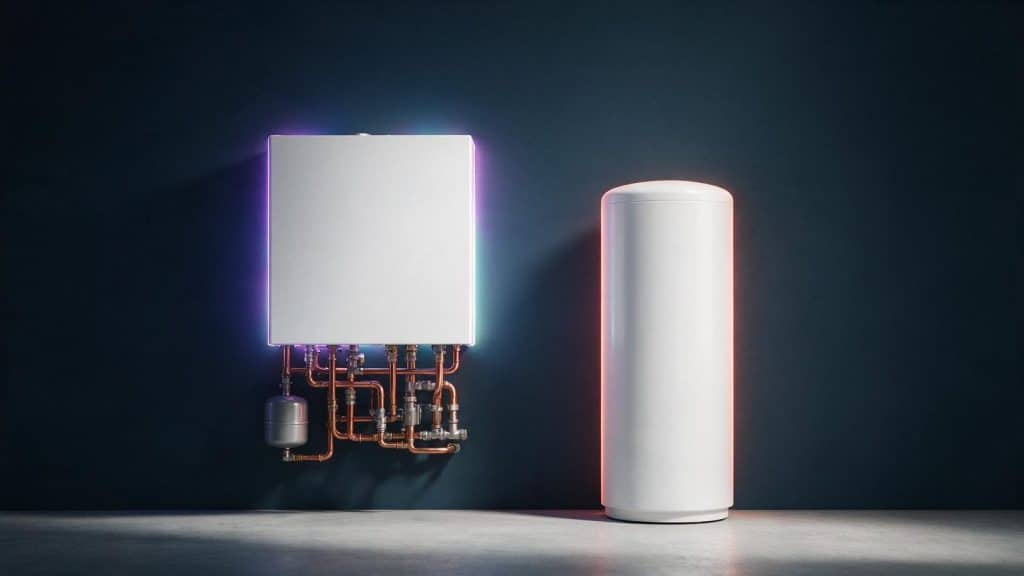
A boiler heats the house. A water heater heats the water you wash in. Two jobs, and across most of the country two separate appliances do them, sitting a few feet apart in a basement and never speaking to each other. Then you get to New England, or upstate New York, or Wisconsin, and one gas burner is quietly doing both. That is the point where boiler vs water heater stops being a product comparison and turns into a question about how your house is plumbed.
So the useful version of the question is not which appliance is better. It is which of three configurations you live with, and which one to move to when something wears out. A separate boiler and a separate water heater. A boiler with an indirect storage tank. A combi that makes domestic hot water on demand with no tank at all. Each trades hot-water capacity against standby loss against what happens the morning the single appliance quits. If your house heats with ducts and a furnace, none of this is your decision, and your live comparison is the ten-year verdict on tank against tankless.
The short answer
- Boiler in the basement, water heater on its last legs: an indirect tank off the boiler you own is the strongest move, and it usually beats the direct-fired tank it replaces on first-hour rating.
- One bathroom, tight mechanical closet: a combi is the configuration that fits, and it runs cheapest of the three.
- Two showers at seven in the morning, or a soaking tub: not a combi. Buy storage, indirect or standalone.
- You want heat and hot water to fail on separate days: keep two appliances. One fault should not take out both jobs in January.
- Forced-air house, no hydronic heat (most of the US): you do not have this choice. Your comparison is tank against tankless against heat pump.
Two jobs that only look alike
A boiler’s water lives in a closed loop. It leaves the appliance around 160 to 180 °F, runs out through baseboard or radiators, gives up its heat to the rooms and comes back to be reheated. The same water goes round for years. Nobody drinks it. A water heater does the opposite job. It lifts cold mains water to 120 or 140 °F and hands it to a tap, after which it leaves the building for good. Every gallon you use is a fresh gallon heated from ground temperature up.
The two are not even rated on the same scale. A boiler carries AFUE, an annual figure built around a heating season. A water heater carries UEF, measured against a standard daily draw pattern and printed on the FTC EnergyGuide label. Those numbers are not interchangeable, and the moment one appliance does both jobs you lose the ability to look up a single figure that tells you what hot water costs. Hold on to that. It comes back with consequences.
An indirect tank is the middle configuration, and most homeowners have never heard of it. It looks like an ordinary storage tank and it has no burner and no flue. Boiler water circulates through a coil inside it, heat crosses the coil wall, and the potable water warms up without ever mixing with the loop. The boiler becomes the burner for the whole house and the tank becomes a battery.
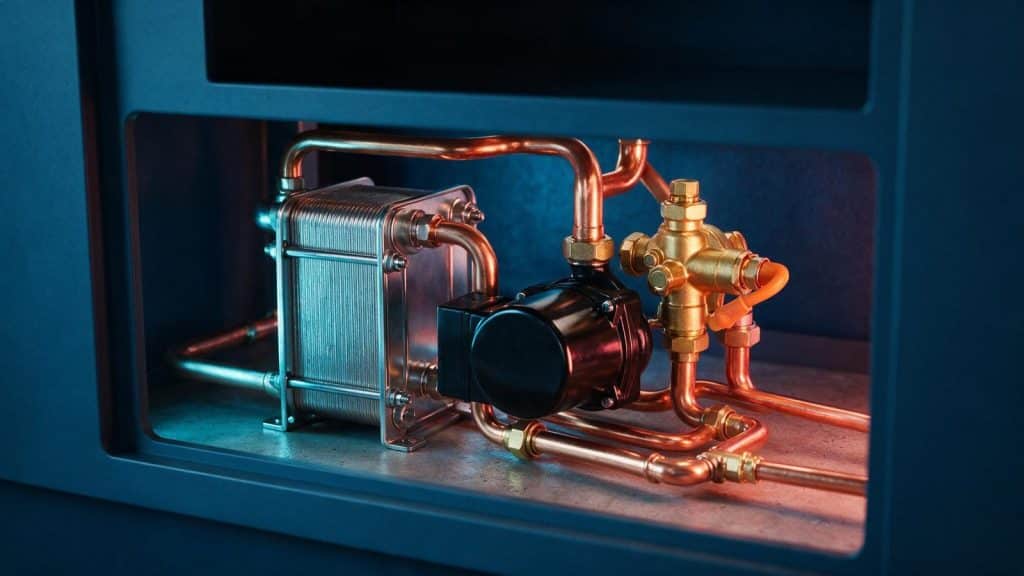
A combi deletes the storage. Cold water runs through a second heat exchanger, picks up heat from the boiler loop on its way past, and arrives hot at the tap seconds later. Domestic hot water takes priority over the radiators, so a long shower in February means the house coasts for a few minutes on the heat already in the loop. That is deliberate and you will not notice it.
Side by side
| criteria | BOILER + TANKtwo appliances | BOILER + INDIRECTone burner, one tank | COMBI BOILERone box, no storage |
|---|---|---|---|
| What heats the tap water | Own burnerindependent gas or electric unit | Boiler coilloop water through a coil in the tank | Boiler, livesecond exchanger, heated as it flows |
| Usable hot water in a rush | ~35 galfrom a 50 gal tank, before it turns tepid | Storage + fast recoveryboiler throws more Btu at the coilbest buffer | Flow onlyroughly 3 to 5 GPM, and rise-dependent |
| Where the standby loss goes | Two jacketsboiler and tank both idle warm | One jackettank loss low, boiler cycles in summer | No storagenothing kept hot between drawslowest idle |
| Ten-year fuel, water side | $3,150gas tank at UEF 0.65 | ≈ $2,550modeled at 0.80, not a rated figureassumption | $2,200condensing DHW at UEF 0.93cheapest to run |
| What one failure takes out | One jobheat or hot water, never bothsafest | Both jobsboiler down means cold showers too | Both jobssingle appliance, single point |
| Equipment, water side | $700–$1,30050 gal gas tank, retail | Tank onlyno burner or flue in the price | Includedthe capability sits inside the boiler |
| Space it occupies | Two footprintsthe least forgiving layout | Boiler + tanktank can be slimmer than a direct-fired one | One wall boxno floor space at allsmallest |
| Household it suits | Risk-aversewants the two jobs kept apart | Busy familytwo bathrooms, hydronic heat already there | Small and tightone bathroom, no room to spare |
Boiler already there and the tank is dying? Indirect, and it is not close. One bathroom in a tight closet? Combi, and enjoy the lowest running cost of the three. Two showers at once? Buy storage, whichever badge it wears.
The arithmetic, and the number nobody publishes
Our standard household needs about 4,000 kWh a year of heat delivered into the water, which is 136 therms of useful heat, and that comes from 64 gallons a day at a 70 °F rise. Divide it by the efficiency of whatever does the heating and you get the energy you actually buy from the utility.
A standalone gas storage tank sits at UEF 0.60 to 0.70. Take the middle: 136 ÷ 0.65 = 210 therms a year, and at $1.50 a therm that is $315, or $3,150 over ten years. A combi making hot water through a condensing exchanger behaves like a condensing tankless unit, so call it 0.93: 136 ÷ 0.93 = 147 therms, $220 a year, $2,200 over the decade. The gap is $95 a year, $950 across ten years. Real money, and smaller than most people expect.
Now the number nobody publishes. A boiler with an indirect tank has no UEF, because the AHRI directory certifies boilers in one program and residential water heaters in another, and what you own is a combination rather than a certified product. So I have to model it, and the model is an assumption. If the pair holds about 80 percent through the summer, when the boiler fires only for hot water and cycles to keep one tank warm, then 136 ÷ 0.80 = 170 therms, $255 a year, $2,550 over ten. Treat that as the weakest figure on this page. A condensing boiler with a heavily insulated indirect beats it. An oversized cast-iron boiler short-cycling through July does not come close, and no label will tell you which one you own.
Capacity behaves differently in each configuration
A 50-gallon tank does not hand you 50 gallons of hot water. It stratifies, cold mains water pushes up from the bottom as you draw, and you stop getting usable heat at roughly 70 percent of nominal capacity. About 35 gallons, then. The number that answers the real question is first-hour rating, which bundles what is stored with how fast heat goes back in, and the difference between that and recovery rate is worth reading properly once before you shop.
Indirect tanks post strong first-hour ratings for their size, and that is the honest case for the configuration. The boiler behind the coil throws far more heat at the water than a tank burner does, so a 40-gallon indirect can behave in a busy hour like a much larger direct-fired tank. Work out what your peak hour actually looks like with the sizing worksheet rather than a rule of thumb. The rule of thumb is what put the undersized tank there in the first place.
A combi has no first-hour rating to give. It has no first hour. What it has is a flow rate in gallons per minute at a stated temperature rise, and the stated rise on the brochure is a flattering one. Groundwater at 42 °F in Minnesota and 70 °F in south Florida asks two different things of the same exchanger, so a unit advertised at 5 GPM can be a 3 GPM appliance in February. Whether that exchanger condenses moves efficiency by the margin the condensing arithmetic gives on any tankless unit. I keep meeting people who put a combi into a four-bedroom house with two busy bathrooms and then blame the brand. The brand is fine. The configuration was wrong.
One appliance means one failure
Here is the trade that decides this for a lot of households, and it never shows up on a spec sheet. With two appliances, a failure is an inconvenience. The tank goes and the house is still warm. The boiler goes in January and you are cold, but you can still shower while you sort it out. Fold both jobs into one appliance and one fault takes both away on the same morning.
Storage tanks run 8 to 12 years on our constants list, and that clock is set by water chemistry rather than the calendar. The anode gives up, then the steel starts, and hardness moves that date more than any badge does. An indirect has the same exposure to your water but carries no burner and no flue, which removes a whole category of components that can fail.
And here is where I stop being useful. There is no public model-level failure database for water heaters. None exists. No manufacturer publishes failure rates, no federal agency collects them, and every durability ranking you will find online is one contractor’s local sample dressed up as data. So I cannot tell you whether an indirect outlives a direct-fired tank in your water, and nobody honest can. The warranty tier is the closest thing to a published bet a manufacturer ever makes, and I read it that way.
Where boiler vs water heater is not a real choice
Hydronic heating is a regional habit. It is common in the Northeast and across the upper Midwest and scarce almost everywhere else, where forced air won the argument decades ago. If your house has supply registers in the floors and a furnace in a closet, you do not have a boiler and you will not be getting one to make hot water. This page is background. Your choice is between appliance types, not configurations.
The concession I owe you is on my own preference. I said above that I like keeping the two jobs on two appliances, and there is a case where that is plainly wrong: the house where the boiler is being replaced anyway. Adding an indirect while the burner is already coming out is a different proposition from adding one on its own, and it is the one situation where I would drop the separate water heater without hesitating. The other is the townhouse closet where a wall-hung combi is the only way both jobs fit in the space that exists. Physical reality beats a preference every time.
Sources
- DOE Energy Saver, water heating pages covering storage, tankless coil and indirect systems.
- AHRI Directory of Certified Product Performance, which runs separate certification programs for residential boilers and for water heaters. That is why a boiler-plus-indirect pair carries no single rating.
- FTC EnergyGuide label, where UEF and first-hour rating appear on a storage water heater.
- ENERGY STAR certified product finder, which lists boilers and water heaters as distinct categories with distinct criteria.
- Manufacturer specification sheets for combi boilers and indirect tanks: hot water flow quoted at a stated rise, and coil ratings.
- US EIA residential gas and electricity price series, used to sanity-check our $1.50 per therm and $0.17 per kWh constants.
Take the reframing if you take nothing else. There is no contest between a boiler and a water heater, because they were built for different jobs. The real decision is whether one appliance should do both, and it turns on how much hot water the house needs in its busiest hour and how much you mind losing heat and showers on the same morning. Every figure above uses the assumptions we apply to every comparison here, and you can check them on our method page.