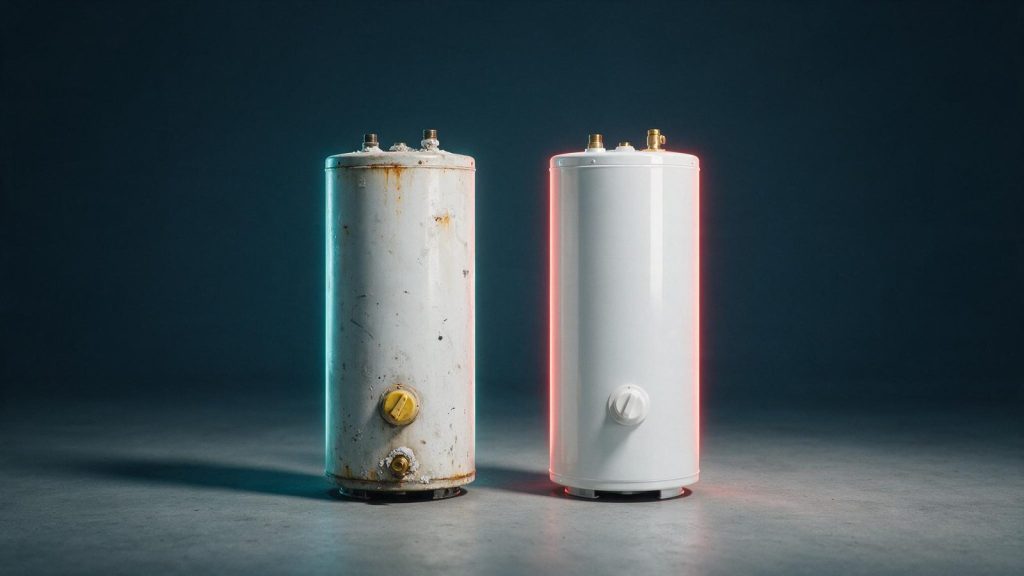
A water heater does not wear out the way a car wears out. It corrodes quietly for years and then, one morning, there is water on the floor and the decision has already been made for you. Which is why the standard answer to how long do water heaters last — eight to twelve years for a storage tank, fifteen to twenty for a tankless — is both true and close to useless. That band is an average taken across every water chemistry in the country. Your house only has one.
The number that actually predicts your tank’s life is not printed on the appliance. It is in your water utility’s annual quality report, written in grains per gallon, because water chemistry is what sets the pace at which the sacrificial anode rod is eaten. When the anode is gone, the steel is next, and the steel is the tank. Everything below follows from that one fact. If the unit in your basement is tankless, the clock runs on a different mechanism entirely and I have written that up in the piece on tankless lifespan and scale.
The short answer
- Municipal water, moderate hardness, gas or electric tank: eight to twelve years is the right expectation, and year eight is when you start budgeting rather than start worrying.
- Well water or anything above roughly 10 grains per gallon: plan for the bottom of that band. Scale builds on the tank floor and the anode works harder from day one.
- Softened water: the harsher case for the anode, not the gentler one, and several manufacturer warranties carve out damage traced to water treatment. Read yours.
- Buying now and staying in the house: climb the warranty ladder. The twelve-year tier costs more today and less per warranted year, and the money buys anode, not badge.
- Selling or renting inside three years: the six-year tank is the honest purchase. You will not be there for the payoff.
- Tankless or heat pump: fifteen to twenty years and ten to fifteen, on different failure mechanisms. Neither dies the way a tank dies.
So how long do water heaters last on your water?
A storage tank is a welded steel vessel with a glass lining fused to the inside. The lining is good and it is never perfect. Every weld seam, every fitting penetration, every hairline flaw in the glass leaves bare steel exposed to hot, oxygenated, mineral-loaded water, which is an excellent environment for rust. So manufacturers hang a rod of magnesium or an aluminum-zinc alloy inside the tank and let it corrode instead. That is the whole trick. The anode is more electrochemically willing to give up electrons than the steel is, so it dissolves first and the tank does not.
So the tank has no calendar. It has a consumption rate. That rate rises with temperature, with dissolved solids, and with anything that makes the water more conductive, which is why two identical tanks installed on the same day in different counties can fail years apart with nobody doing anything wrong. Hardness does its damage a second way. Calcium and magnesium drop out of solution as the water heats and settle as scale on the tank floor, directly over the burner on a gas unit, insulating that patch of steel from the water it is meant to be heating and letting it run hotter than the design intends.
Softening the water does not remove the problem, it moves it. Ion exchange trades calcium and magnesium for sodium, which stops the scale and raises conductivity, and higher conductivity means the anode goes faster. Very soft and very hard shorten the clock from opposite ends. The middle of the range is the kindest place a tank can live, and almost nobody gets to choose. The anode is a serviceable part on an inspection interval measured in years rather than months. This site does not publish maintenance procedures, so I will note that the interval exists and stop there.

Side by side
Here is the part of the argument that most lifespan articles skip. The manufacturer sells the same tank in three warranty tiers, and the difference between the tiers is largely the anode arrangement. That makes the ladder a price list for corrosion protection, published by the only people who hold the claim data.
| criteria | 6-YEAR TIERentry line | 9–10 YEAR TIERmid line | 12-YEAR TIERtop line |
|---|---|---|---|
| Warranted tank life | 6 yrshortest published bet | 9–10 yrthe volume tier | 12 yrlongest on the shelflongest cover |
| Anode provision, per spec sheets | One rodstandard magnesium or alloy | Heavier rodlonger or thicker element | Two rodsor a powered rod on some modelsmost metal |
| Where it sits, 50 gal electric | ~$600bottom of the $550–$900 bandleast cash out | ~$750middle of the band | ~$860top of the band |
| Cost per warranted year, electric | $100600 ÷ 6 | $83750 ÷ 9 | $72860 ÷ 12cheapest per year |
| Same sum, 50 gal gas | $130780 ÷ 6 | $1171,050 ÷ 9 | $1041,250 ÷ 12cheapest per year |
| What the document actually covers | Tankshorter parts term, registration often required | Tank + partsparts term usually matches the tank | Tank + partslongest parts term, same exclusions |
| Household it suits | Short stayrental, sale inside three yearsright call | Most housesmunicipal water, moderate hardness | Long stayhard or softened water, staying putright call |
Staying put, on hard or softened water? The twelve-year tier is the cheaper bet per warranted year, and the second anode is what you are paying for. Selling inside three years? Buy the six-year tank and keep the difference. Everything in between? The mid tier exists because it is right most of the time.
Prices above are equipment only, from this site’s standing bands. Installation is local and I do not quote it. The brand-level version of the same tier argument runs through the Rheem and A.O. Smith comparison, where the two ladders sit side by side and the badge matters less than the rung.
The failure database that does not exist
I want to be blunt here, because this is where articles on this keyword quietly start inventing things. There is no public, model-level failure database for water heaters in the United States. No agency publishes a mean time between failures for one tank against another. Manufacturers hold their own claim rates and have no reason to release them. Plumbers have samples, and a plumber’s sample is real information about one county’s water and one decade’s product, which is not the same thing as data. Consumer surveys measure who was annoyed enough to answer, not who leaked.
So the warranty ladder is doing more work than it looks like it is doing. A company that prints twelve years on a jacket has priced the odds of paying out over twelve years, using claim data you will never see. That makes the tier the closest thing to a published reliability estimate in this category. It is a weak instrument. It is also the only one on the shelf, which is why I read it as a specification rather than a sales feature, and why a brand ranking with no tiers attached tells you nothing. That argument runs at full length in the brands piece.
Here is the concession, and it is a real one. Everything I have said about how fast an anode is consumed is directional, not quantified. I cannot give you years per grain of hardness, because that figure does not exist in any source I would be willing to cite. I keep meeting people who paid the premium for a twelve-year tank and then put in a softener without reading the warranty exclusions, and people who dropped a six-year tank into a well-water house at eighteen grains and felt cheated when it went at year five. Both bet the wrong way. Both could have got a better answer, free, from their utility’s annual water quality report.
Why replacing on your schedule is worth real money
Knowing your own clock will not stop the leak. It buys you the chance to make an expensive decision calmly, a year early, instead of at eight in the morning with a wet floor. That is where the money is, because the technology you land on matters more than the badge or the tier.
Run it. This site models a household using 64 gallons a day at a 70 °F rise, which works out to roughly 4,000 kWh a year of delivered heat. An electric resistance tank at UEF 0.92 has to put in 4,000 ÷ 0.92 = 4,348 kWh, and at $0.17 a kilowatt-hour that is about $739 a year. A heat pump unit at UEF 3.5 needs 4,000 ÷ 3.5 = 1,143 kWh, or $194. The gap is roughly $545 every year, for the ten to fifteen years the heat pump lives. Over a decade that is around $6,700, against an equipment premium of about six hundred to eighteen hundred dollars.
A tank that fails on a Sunday gets replaced with whatever is in stock, in the same footprint, on the same fuel. Nobody runs that division standing in a puddle. The federal credit that used to apply to heat pump water heaters lapsed at the end of 2025, so what remains is utility and state incentives where they are offered, and those move by ZIP code rather than by act of Congress. If the tank-or-tankless question is still open, the ten-year verdict settles it on these same constants. Replacing while the heat pump is already the plan: the best heat pump water heater by household walks through the room and panel checks first.
Signs the clock is nearly out
Age first. The manufacture date is encoded in the serial number on the rating plate, and it tells you when the tank was built rather than when it went in. The two can sit a year apart. Past six years on a six-year tank you are on borrowed time by the manufacturer’s own reckoning. Past twelve on any tank you are gambling with a floor.
The useful signals after that are about the water, not the noise. Rusty or metallic hot water that runs clear on the cold side says the lining has been breached. Recovery that has slowed over a couple of years on a gas unit usually means sediment is sitting between the burner and the water. Weeping at a seam is terminal. A leaking tank is finished, and unlike a tankless unit with a dead fan or board there is no part to change. I would not put money into a tank that has started to seep. I would put that morning into choosing the replacement properly.
Sources
- DOE Energy Saver, water heating pages — service life ranges for storage, tankless and heat pump units.
- Manufacturer residential warranty documents (Rheem Performance, Performance Plus, Performance Platinum; A.O. Smith Signature series; Bradford White residential) — tank and parts terms, registration requirements, water-condition exclusions.
- Manufacturer specification sheets — anode arrangement, tank construction and lining by tier.
- AHRI Directory of Certified Product Performance — UEF and first-hour rating figures.
- FTC EnergyGuide label — the annual energy cost basis printed on the unit.
- US Energy Information Administration — residential electricity and natural gas price series.
- Your local water utility’s annual water quality report — hardness in grains per gallon at your address.
The honest summary is that a water heater lasts as long as its anode lasts, that your water decides the anode, and that the warranty tier is the manufacturer betting its own money on how long that will be. Treat the eight-to-twelve figure as a starting bracket and then narrow it with the two things you can actually check: the hardness of your supply and the number of years printed on the jacket. Every band, price and efficiency figure used here comes from the same fixed set of assumptions, laid out on the method page.