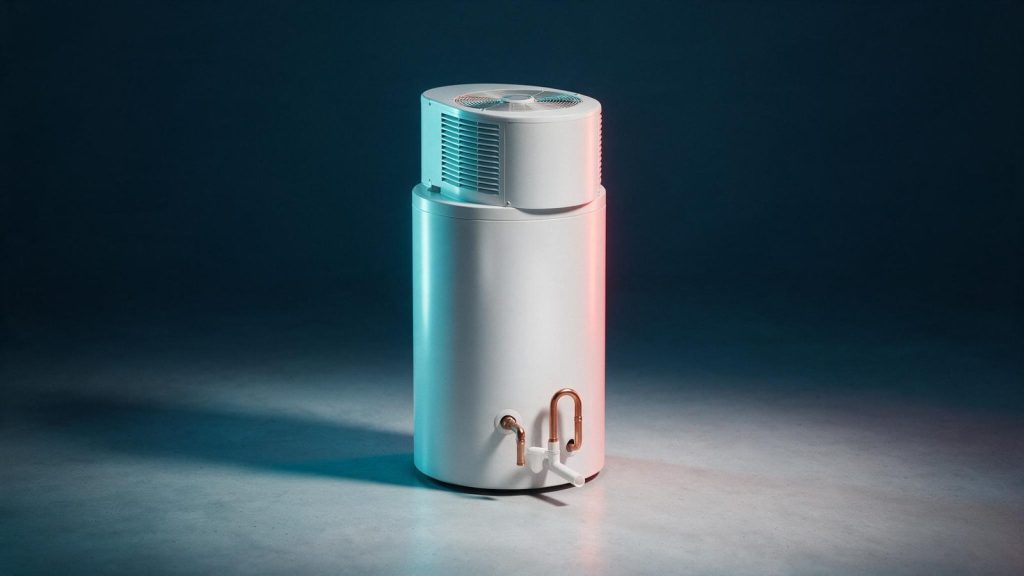
A hybrid water heater is a heat pump with a pair of ordinary resistance elements bolted in as backup, and almost every list of hybrid water heater pros and cons treats those elements as a footnote. They are not a footnote. They are the reason two identical units in two different houses can post running costs that differ by a factor of three, with nothing wrong with either appliance.
There is a mode switch on the front of the thing, and which mode it lives in is worth more money than any other decision you will make about it. So this piece prices the modes against each other at identical delivered heat, then works through what a heat pump does to the room it stands in, because that is where the honest objections live. If you are earlier in the decision than that, the tank-against-tankless comparison is the better place to start.
The short answer
- All-electric house, garage or unfinished basement, warm state: buy it. On the compressor it runs at $194 a year against $739 for a resistance tank at this site’s constants, and nothing else in an all-electric house is close.
- All-electric house, tight closet inside the heated envelope: think harder. It needs air volume, and in winter it takes back heat you already paid to make.
- Four people, a 50-gallon unit, showers stacked back to back: the elements will carry a share of the load and the savings shrink in proportion. Size up, or budget for a blended number.
- Gas already at the meter with a working flue: weaker case. A gas tank swap is the cheap replacement and the heat pump starts a lap behind.
- Unheated space that drops near freezing in winter: it falls back on the elements in the exact months you wanted the savings.
- Anyone who plans to leave it in electric-only mode: do not buy one. That is a $1,500 to $2,400 appliance doing a $550 to $900 appliance’s job.
What the mode switch actually does
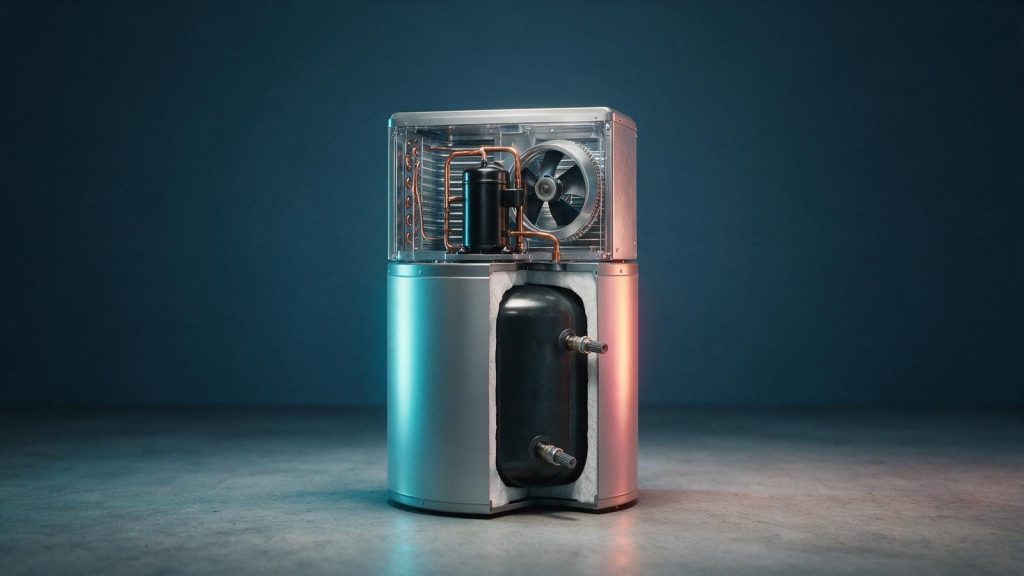
Names vary by manufacturer, so read the spec sheet for the exact wording, but the four behaviours underneath are the same everywhere. Efficiency mode locks the unit to the compressor and never energises the elements. Hybrid or auto mode runs the compressor and calls the elements in when the tank falls behind demand. High demand shifts that threshold sharply toward the elements so the tank recovers fast. Electric mode switches the compressor off entirely and runs the appliance as a plain resistance tank.
That last mode exists for good reasons. A compressor sitting in a 35 °F garage in February has almost no heat to move, so the appliance protects itself. Manufacturer sheets list an ambient operating band, commonly starting somewhere around 37 to 45 °F, and below it the elements take over whether you asked them to or not. The trouble is that most of the units I read about being left in electric mode were put there by a person, after a cold shower, and never moved back.
A heat pump does not make heat. It moves heat, from the air in the room into the water, which is why a unit can deliver three to four units of heat for every unit of electricity it draws. An element makes heat, at one for one. Those two sentences are the entire pros-and-cons argument, and everything below is arithmetic on top of them.
Hybrid water heater pros and cons, side by side
| criteria | COMPRESSOR ONLYefficiency mode | MIXEDa quarter on elements | ELECTRIC ONLYcompressor off |
|---|---|---|---|
| Effective UEF | 3.5site constant for a heat pump3.8x better | 2.06blended, not a label figure | 0.92a resistance tank, exactly |
| Electricity drawn per year | 1,143 kWh4,000 kWh of heat ÷ 3.5 | 1,944 kWh857 on the compressor, 1,087 on the elements | 4,348 kWh4,000 ÷ 0.92 |
| Running cost per year | $194at $0.17 a kilowatt-hourcheapest | $330the mode most units actually sit in | $739the appliance you were replacing |
| Over ten years | $1,940roughly one purchase price | $3,300$1,360 of the saving gone | $7,390$5,450 worse than the compressor |
| Recovery after a long draw | Slowcompressor output is modest by design | Moderateelements close the gap on demand | Fastfull element output, all the timefastest |
| Sound while heating | Fan and compressorspec sheets quote high 40s of decibels | Fan and compressormost of the running hours | Silentno moving partsquietest |
| Effect on the room | Cools and driesa gift in a humid basement, a tax in a cold one | Cools and dries lessscales with compressor hours | Noneand no condensate to drain |
Buying one to leave in electric mode? Buy the plain tank and keep the difference. Buying one for a warm garage or a damp basement in an all-electric house? Efficiency mode is the cheapest hot water available to you, and the second column is what it costs to get impatient.
Where the savings leak out
Start from the heat, not the appliance. The household this site models uses 64 gallons a day at a 70 °F rise, which is 13,637,568 BTU a year of heat actually delivered to the taps, or 4,000 kWh. Whatever the appliance is, the energy it draws is that number divided by its UEF. A heat pump at 3.5: 4,000 ÷ 3.5 = 1,143 kWh, which is $194 at $0.17 a kilowatt-hour. A resistance tank at 0.92: 4,000 ÷ 0.92 = 4,348 kWh, or $739. The gap is $545 a year and $5,450 over ten. It is the widest running-cost spread available in a domestic appliance, and I have written about that gap on its own because it deserves the room.
Now split the heat, which is what a hybrid actually does. Say a quarter of the year’s delivered heat ends up coming off the elements: 3,000 kWh of it at 3.5, and 1,000 kWh at 0.92. That is 857 kWh plus 1,087 kWh, so 1,944 kWh in total, and $330 a year. Read those two figures again before moving on. The quarter of the heat that came off the elements drew more electricity than the three quarters that came off the compressor. That is the whole catch, in one line.
So the practical question stops being “is a hybrid efficient” and becomes “what fraction of my hot water will come off the compressor”. Three things push that fraction down. An undersized tank, because a compressor recovers slowly and the controller reaches for the elements when the tank cannot keep up. High-demand mode left switched on after a house guest went home. And a cold room, which derates the compressor before anyone touches anything. The first of those is a sizing problem, not a heat pump problem, which is why first-hour rating and recovery rate matter more on this appliance than on a gas tank, and why it is worth running the sizing worksheet before you shop rather than after.
The room pays part of the bill
The heat has to come from somewhere, and it comes from the air around the unit. Manufacturers put a floor on that, usually somewhere in the region of 700 to 1,000 cubic feet of unrestricted air space, or a louvred arrangement that borrows air from elsewhere. Put one in a sealed closet and you get an appliance that is either derated or running on its elements, which is the same failure by a different route.
What it does with that air cuts both ways, and this is the part I think gets flattened into a bullet point too often. Pulling heat out of basement air cools and dehumidifies it. In a Houston garage or a damp Georgia basement that is a genuine second benefit, and some people run a dehumidifier down there already. In a heated Minneapolis basement in January it is a hidden cost: the furnace makes that heat back, so part of your water heating bill quietly moves onto the gas bill. Nobody puts that on the EnergyGuide label. There is also condensate, because pulling moisture out of the air produces water that has to be drained or pumped away, which is a consideration in a room without a floor drain.
Then noise. A fan and a compressor run for several hours a day, and the sound ratings on spec sheets tend to land in the high 40s of decibels, which reads as quiet on paper and as a small refrigerator in practice. I would not put one in a finished basement on the other side of a bedroom wall, and I would not put one in a closet in a cold climate, and I say that as someone who thinks a hybrid is the best value in an all-electric house by a wide margin.
The thing I cannot tell you is how long the compressor lasts. There is no public model-level failure database for water heaters in the United States, so any figure you read about hybrid reliability is somebody’s local sample or somebody’s affiliate page. What exists is the warranty, which is the manufacturer’s own money on the line, and typical heat pump lifespan is quoted at 10 to 15 years against 8 to 12 for a plain tank. That is the closest thing to evidence on offer, and it is thinner than anyone selling one will admit.
The price gap, and how fast it closes
Equipment only: a 50 to 65 gallon hybrid runs $1,500 to $2,400, and a 50 gallon electric tank runs $550 to $900. Take the middles and the gap is about $1,225. At $545 a year saved on the compressor, that closes in a bit over two years. Take the pessimistic ends, $2,400 against $550, and the $1,850 gap closes in about three and a half. Take the optimistic ends, $1,500 against $900, and it closes in thirteen months. Every one of those lands well inside the appliance’s life, which is unusual for an efficiency upgrade.
Two honest caveats on that paragraph. It is equipment price only, because what a plumber charges to fit either one is a local number and I am not going to invent it. And it assumes no subsidy at all: the federal 25C credit that used to take a bite out of the purchase expired on 31 December 2025, so it should not be in anybody’s spreadsheet now. Utility and state incentives, where offered, are still worth ten minutes of checking, and they only make the arithmetic above better. If the house has gas at the meter the sum is different again, and the crossover against a gas tank depends on your local price ratio rather than on anything I can settle here.
Against the other modern option
Most people weighing a hybrid are also, somewhere in the same browser session, looking at tankless. They are not competitors so much as answers to different questions. Tankless buys continuity and floor space and a 15 to 20 year life. A hybrid buys running cost and nothing else, and it still has a tank with all the standby loss and the eventual leak that implies. The running-cost comparison is closer than people expect once fuel is settled: a condensing gas tankless comes out at $220 a year on these constants against the hybrid’s $194, near enough a tie, except one of them needs a gas line and a flue and the other needs a big enough room. That is the real fork, and it is worked through properly in heat pump against tankless.
Sources
- DOE Energy Saver, heat pump water heater guidance for ambient air and space requirements.
- AHRI Directory of Certified Product Performance, for UEF and first-hour rating on specific models.
- ENERGY STAR certified product finder, for the current qualifying heat pump water heater list.
- FTC EnergyGuide label, which prints the estimated yearly energy cost at the label’s own national rate.
- Manufacturer specification sheets and warranty documents, for operating modes, ambient operating band, sound rating and required air volume.
- US Energy Information Administration, for residential electricity and natural gas prices.
A hybrid is the cheapest hot water an all-electric house can buy, and it is also the appliance most easily talked out of its own advantage by a cold room, a small tank or an impatient owner. Buy it for a space that can feed it air, size it so the elements stay asleep, and check the mode switch once a year. Every figure above comes from the same set of assumptions, and you can see them and change them on the method page.